
Vietnam's Digital Transformation Is No Longer a Roadmap. It Is a Budget.

Rosie Nguyen
21 July 2026
Insights from the Scaling Business Summit 2026, Ho Chi Minh City.
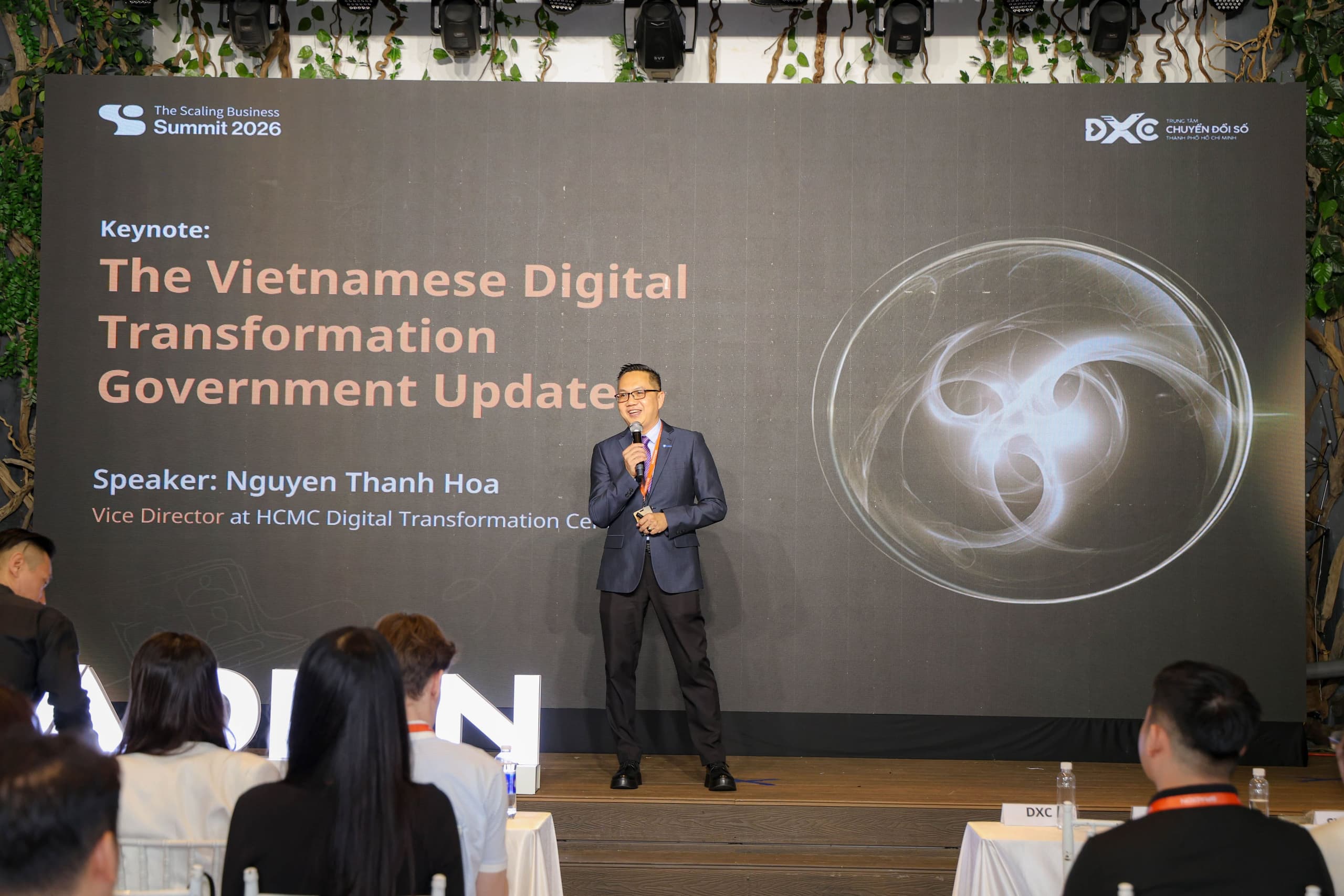
Most government presentations at business events describe ambition. Nguyen Thanh Hoa's did not. As Vice Director of the Ho Chi Minh City Digital Transformation Center (HCMC - DXCENTER), he presented a budget, a timeline, and a set of already-completed milestones, the kind of specificity that signals execution rather than aspiration.
The HCMC - DXCENTER sits inside the People's Committee of Ho Chi Minh City. Its job is not strategy that belongs to the Department of Science and Technology but implementation. In 2025, that meant preparing 168 wards across the city for a new two-tier administrative system, running 75 digital transformation training classes for 15,000 attendees, and standing up the infrastructure stack that everything else depends on.
For any private company operating in Vietnam, or considering it, this session was a signal map: where the government is spending, what it is building, and what it expects from the private sector in return.
1. The Administrative Restructuring Is the Foundation, Not the Feature
The headline governance change is structural. Vietnam eliminated the district level of administration in 2025, moving from a three-tier system (province, district, ward) to a two-tier system (province and ward). Nationwide, the number of wards dropped from over 10,000 to 3,321. Ho Chi Minh City now operates across 168 wards, down from a significantly larger number after its merger with Binh Duong and Ba Ria-Vung Tau provinces.
The implication for digital transformation is direct: every ward needed to be brought onto a unified system, trained to the same standard, and capable of delivering government services online. Nguyen Thanh Hoa taught 75 of those training classes himself. The point was not cosmetic. Without administrative standardization, the data systems, the super app, and the service delivery platforms that sit on top have no consistent foundation to operate from.
This matches the pattern that Gradion's own team has observed in enterprise transformation: before the AI, before the agents, before the automation, the data must be clean and the organizational structure must be rationalized.
Lesson 1: Digital transformation at scale requires administrative simplification first. The technology layer is only as good as the governance layer underneath it.
2. Four Resolutions, One Direction: Policy Is Now Aligned Behind Technology
Four national resolutions issued in the past year define the policy environment that Ho Chi Minh City is now operating within. Taken together, they represent the most comprehensive alignment of Vietnamese government policy behind technology investment in the country's modern history.
Resolution 57 is the most significant for the technology sector. It focuses on science, technology, innovation, and digital transformation, and mandates a ten-fold increase in public spending on these areas. Vietnam currently allocates approximately 0.5% of public expenditure to science and technology. The target is 4 to 5%. At Ho Chi Minh City's scale, this represents a structural change in the capital available for technology procurement, research partnerships, and infrastructure investment.

Resolution 59 addresses international integration, opening more active collaboration with Europe, Asia, and other continents.
Resolution 66 and 68 focus on policy reform and private sector development, targeting the bottlenecks that have historically slowed the connection between government agencies, businesses, and the market.
For the private sector, this policy stack means that the procurement and partnership environment in Vietnam is changing.
Nguyen Thanh Hoa was explicit about the intent: "We look into market-driven innovation. We have policy support, we have incentives."
Lesson 2: Vietnam's policy environment is no longer cautious about technology investment. Four active resolutions point in the same direction. The question for private companies is whether they are positioned to be the implementation partner.
3. The Strategic Technology Bets: AI, Semiconductors, UAVs, and Digital Twins
Ho Chi Minh City is aligning its technology investment to the national strategy. The priority sectors are artificial intelligence, semiconductors, unmanned aerial vehicles (UAVs), biomedical science, and stem cell research. Each of these has concrete institutional backing already in place.
On semiconductors: Viettel is actively working on semiconductor research, and a private company in Binh Duong province is preparing a 1,000-hectare land allocation specifically for UAV production and testing, a facility designed for what Nguyen Thanh Hoa described as the low altitude economy, covering the airspace from zero to 1,000 meters. This is not a pilot. It is a dedicated industrial zone.
On digital twins: the city is running active digital twin projects at three locations, Con Dao Island, a ward in Saigon, and a ward in Vung Tau province. These are paired with a citywide IoT infrastructure upgrade valued at approximately $140 million USD, which will upgrade connected devices and sensors across the metropolitan area.
On healthcare and education data: the HCMC - DXCENTER is partnering with Liverpool through a sister-city relationship to develop health system data infrastructure, and working with Google to support AI integration in Ho Chi Minh City's education system.
Lesson 3: Vietnam's technology bets are specific, funded, and spatially allocated. For companies in AI, semiconductors, UAVs, biomedical technology, or smart infrastructure, the government procurement pipeline is real and growing.
4. The Data Infrastructure: Super App, Exchange Platform, and 155 Terabytes
The most tangible piece of citizen-facing infrastructure is the eCitizen super app, available on both iOS and Android. As of the presentation, it had 620,000 downloads and over six million interactions. The stated goal is to reach all 14 million citizens of Ho Chi Minh City, connecting them to government services, administrative processes, and eventually to the broader city data ecosystem.
Behind the app, the HCMC - DXCENTER manages a data center holding 155 terabytes of government data. In the near future, the center is building a data exchange platform, described as the first of its kind in Vietnam, designed to enable structured data sharing between agencies, departments, and eventually private sector partners.
On cybersecurity: Vietnam is building a national data center in Hanoi with a second center planned for Ho Chi Minh City, developed in partnership with the Ministry of Public Security. The personal data protection law is now in effect, and Nguyen Thanh Hoa was clear about its implications, every organization handling Vietnamese citizen data now operates under a legal framework that requires careful compliance behavior.
The cybersecurity framing was practical: "Every year, a lot of people in Vietnam are victims of online scams and cyber attacks."
Lesson 4: Vietnam's data infrastructure is being built in public, with clear architecture. Companies that design their data practices around the emerging national framework will have a structural advantage over those that retrofit later.
5. Speed Is the Metric and the Government Is Measuring Itself Against It
The most striking moment of the presentation was how Nguyen Thanh Hoa defined success. Not adoption rates. Not platform counts. Not headcount trained.
"Digital transformation is about one word: speed. If we cut off the intermediary levels and don't improve the speed, that is not digital transformation at all."
The macro ambition is commensurate with that framing. Vietnam is targeting upper middle income status. To reach it, the plan requires every city and province to sustain double-digit GDP growth - 10% per year for ten consecutive years, followed by 7% for the following ten. Nguyen Thanh Hoa's summary: it is a marathon, not a sprint, but it is a marathon at pace.

The $600 million USD budget for science, technology, innovation, and digital transformation in 2026 is the financial expression of this ambition. It includes research projects, infrastructure, and the innovation centers being established at universities across the city designed to close the gap between knowledge produced in academia and applications deployed in the market.
For the HCMC - DXCENTER itself, the five-year target is to become a Center of Excellence, not just a government implementation arm, but a research-capable institution that can contribute to market-driven innovation alongside the private sector. The partnership with Gradion, described as a first-time collaboration, was cited as an example of the kind of government-private sector cooperation the center is actively pursuing.
Lesson 5: Speed is now a government KPI in Vietnam. The administrative, policy, and infrastructure changes of the past year are oriented around execution velocity. For private companies, the window for early partnership is open and narrowing.
The CEO Execution Playbook: What to Do Tomorrow
- 1. Review Vietnam's data protection law for your current operations. The personal data protection framework is now active. If you handle Vietnamese citizen data, map your current data flows against the legal requirements. The cost of retrofit is always higher than the cost of design-in.
- 2. Identify your government procurement angle. Resolution 57 commits Vietnam to a 10x increase in technology spending. That capital needs implementation partners. If your company operates in AI, infrastructure, IoT, cybersecurity, digital twins, or training, determine whether you are positioned to respond to procurement tenders and what qualification requirements apply.
- 3. Connect with the university innovation ecosystem. The HCMC - DXCENTER is establishing innovation centers at universities across Ho Chi Minh City, designed explicitly to bridge research and commercial application. For technology companies looking for R&D partnerships, talent pipelines, or proof-of-concept environments, these centers are the intended channel.
- 4. Track the data exchange platform. Vietnam's first government data exchange platform is in development. When it launches, it will create structured access to government datasets for private sector partners who meet the criteria. Monitor the timeline and prepare your data integration capability now.
- 5. Treat the ward-level digital rollout as a distribution signal. 168 newly standardized, digitally connected wards in Ho Chi Minh City means 168 administrative units that can now receive, process, and act on digital service requests. For companies with citizen-facing products or services, this is a new last-mile infrastructure layer and it is being built for you.
About the author
Rosie Nguyen
Rosie Nguyen works at the intersection of Marketing, Communications, and meaningful Storytelling at Gradion. She covers leadership and scaling, writing for the founders and operators building across Asia.
The Window for Early Partnership Is Open.
Vietnam's policy and procurement environment is moving fast. If you want to position before the market catches up, Gradion can help you think through the next step.