
Rethinking Speed: Lessons Europe Can Learn from Vietnam

Rosie Nguyen
28 May 2026
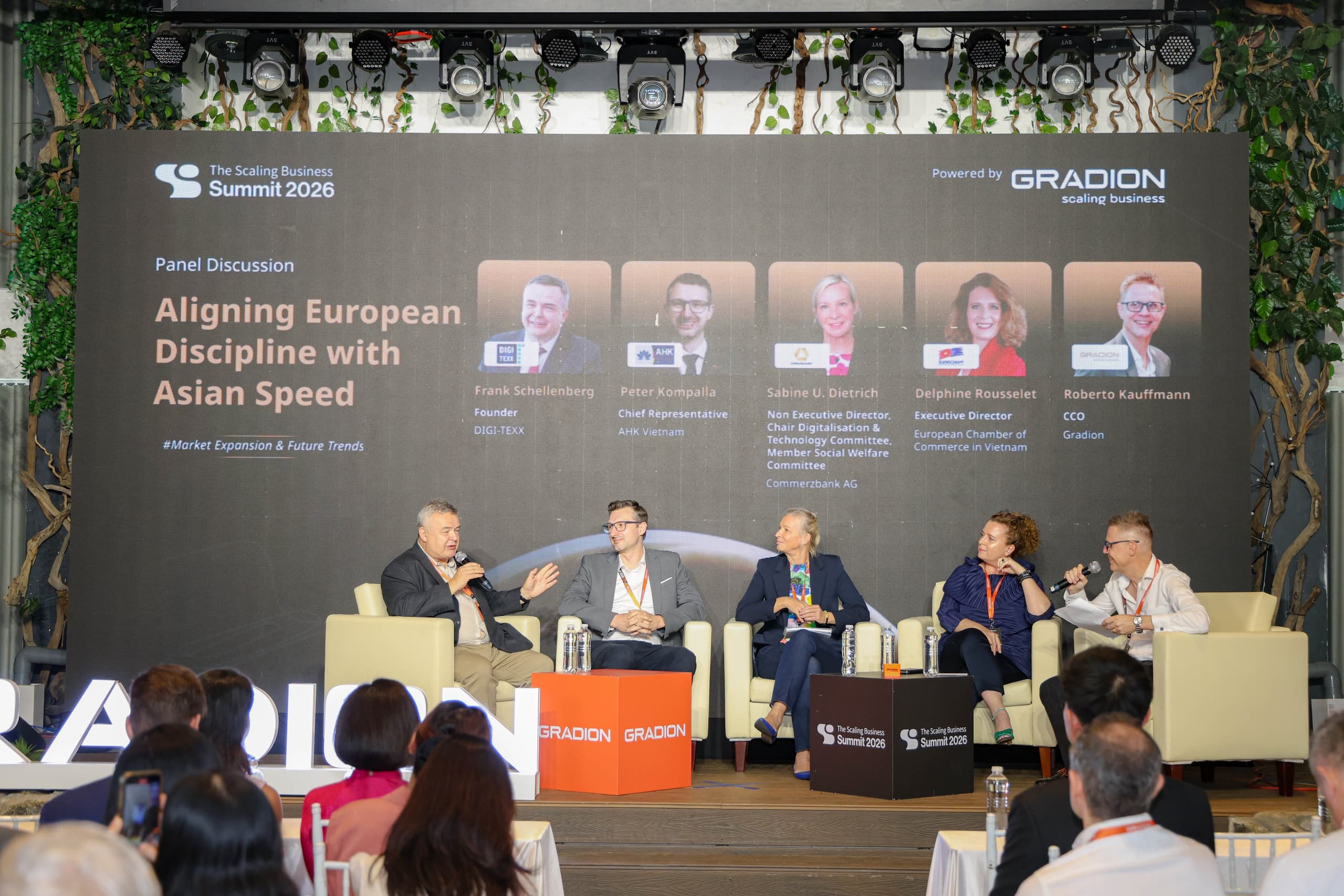
Insights from the Scaling Business Summit 2026, Ho Chi Minh City.
Five months to get headquarters approval. Four weeks to build the thing. That ratio of European governance versus Asian execution is the gap this panel came to close.
Moderated by Roberto Kauffmann, Former COO at Gradion, the panel brought together Frank Schellenberg, Founder and Chairman of DIGI-TEXX; Peter Kompalla, Chief Representative at AHK Vietnam; Sabine U. Dietrich, Non-Executive Director at Commerzbank AG; and Delphine Rousselet, Executive Director of the European Chamber of Commerce in Vietnam. Between them: decades of building businesses across two operating cultures.
The question on the table was deceptively simple. Is Asian speed versus European quality a real tension or a false binary? What the panel delivered was sharper than either answer: a practical guide to operating across both.
1. Speed and Quality Are Not Opposites
The cliché runs in both directions. Europe: slow, careful, excellent. Asia: fast, chaotic, good enough. The panel took ten minutes to dismantle it.
Frank Schellenberg built DIGI-TEXX into a 1,200-person operation across three locations in Vietnam. His company's proposition is built on a deliberate collision of the two cultures. “German quality, made in Vietnam.” Not one or the other. The premise is that speed and quality are only opposites if you let them be.
Sabine Dietrich's reference point was the 80/20 rule - 80% of results come from 20% of effort, and the remaining 20% of results require 80% of effort. The implication for cross-cultural teams: not everything requires 100% quality. The discipline is in knowing which category you are in, and then moving accordingly. “I am not convinced that quality at 100% is required for everything. You need to be able to manage risk and determine what level of quality is right, and then you iterate.”
The tension, as Peter Kompalla put it, is cultural: “The culture here is no fear, go for it, and then solve it. Germany wants to plan carefully, check everything to 100%, and allow no deviation.” Neither approach is wrong. But the company that learns to deploy both European rigor where it counts and Asian momentum everywhere else builds a structural edge over the ones stuck in either extreme.
Lesson 1: Speed and quality are not a trade-off. They are a design choice. The companies winning in Vietnam have learned when to apply each and they use both.
2. Vietnam Just Showed Europe What Speed Looks Like
Peter Kompalla offered a data point that stopped the room. Vietnam is, globally, the country where ease of doing business has improved most over the past 20 years. Steady, consistent, structural improvement year after year, largely invisible to outsiders because the day-to-day still has friction.
But last year, the pace became impossible to ignore. Five ministries merged. Vietnam's 63 provinces were consolidated to 34. An entire tier of public administration was eliminated. Approximately 700,000 public sector roles will be restructured or phased out by 2030. And the government implemented this in under two months.
“Take three federal states in Germany, put them together, say this will be the new capital, and implement it within two months,” Peter said. “When I tell that to visitors from Germany, it is literally impossible to imagine.”

The short-term cost was real: months of confusion, businesses caught mid-process, systems not yet aligned. But the verdict from EuroCham's latest Business Confidence Index is unambiguous. 88% of European businesses in Vietnam say they would recommend the country to other investors the highest reading in seven years. The reform created disruption and then created confidence. That sequence is the pattern.
Lesson 2: Vietnam's administrative transformation is not a news story. It is a business signal. The companies that read it early are already positioning for what comes next.
3. Five Months Versus Four Weeks
Sabine Dietrich's British Petroleum (BP) story is the cleanest illustration of the gap. Her job in the late 1990s: build out a petrol station network in Vietnam. The division of labor was clear. Her role was to work with European headquarters to get the governance right, design approval, sign-offs, compliance. Her team's role was to execute.
Getting headquarters convinced took five months. Building a complete petrol station mockup, canopy, shop, waiting area, bike maintenance, immaculate finish took her Vietnamese team four weeks.
Frank Schellenberg told a version of the same story from 2025. His company needed to move offices at short notice after a fire made their planned building unavailable. As a German, his instinct was that it was not possible in the time available. His team said otherwise. “Frank, no problem, we can do that in two and a half months.” They did. But Frank's German habits added something the speed alone could not: the right cables behind the walls, the correct wire gauges, the proper network infrastructure. Neither side alone would have produced the result. “The mixture is good.”
The underlying principle is consistent: Vietnamese execution speed is real and it should not be managed out of your operation. But speed applied without European-quality checks on the things that matter, the invisible infrastructure, the contractual foundations, the safety standards produces a result that looks finished and breaks later.
Lesson 3: Import the execution speed. Keep the quality check on what you cannot fix later. The combination is where the competitive advantage lives.
4. The Circle of Trust
Peter Kompalla made a distinction that most market entry strategies miss. There are approximately 600 German companies with formal investments in Vietnam. But there are around 4,000 German companies doing business in Vietnam through Vietnamese partners, with no formal investment at all. The second group is larger, often more profitable, and almost never discussed.
The reason the partner model works is structural. Vietnamese business culture operates through what Peter called the circle of trust - a network of relationships that predetermines who gets access to whom and on what terms. “You need an intermediary who gives you access into this circle of trust. This is the challenging thing in the beginning, but if you manage to get there, things get very successful.”
Delphine Rousselet added a warning for companies already operating in Vietnam: changing your key local expert is a higher-risk move than most European headquarters appreciate. “Every time you change an expert, there is a period when that person will be lost in translation, not because they don't speak Vietnamese, but because it takes time to understand the culture.” She recommended intercultural coaches and structured handovers as standard practice. The investment cost of a failed expat rotation including family relocation, six months of confusion, rebuilt relationships is far higher than the cost of getting the transition right.
Lesson 4: Market entry in Vietnam is not a logistics problem. It is a relationship architecture problem. Find your way into the circle of trust before you try to sell anything.
5. The Things They Never Put in the Briefing
Sabine Dietrich arrived in Vietnam as the first female executive for an oil company operating in the country. Her first meetings with local oil industry CEOs, most of whom were also women, which surprised her, followed a pattern she had not prepared for. They asked about her background, her family, and whether she had children.
When she said she did not, the follow-up question was immediate: “Why not?” She answered honestly. The room responded with empathy and warmth. “From that day onwards, I had all doors open and everyone wanted to do business with me.” The 22% market share BP built was built on that foundation.
Delphine offered the complementary insight. In Vietnamese professional culture, when someone is uncomfortable or disagrees, they often smile or laugh. For a European who reads that as dismissal or mockery, the moment can feel hostile. “The day you understand that, everything changes.” It is not a small detail. It is the operating system running underneath every meeting, negotiation, and performance review.
Both stories point to the same gap: the things that determine whether a European professional succeeds in Vietnam are almost never in the job description. The technical brief covers the strategy. The cultural brief, if it exists at all, covers the rest. “Give your experts support,” Delphine said simply. The companies that do that consistently are the ones whose Vietnam operations outlast the first three-year rotation.
Lesson 5: Cultural fluency in Vietnam is not a soft skill. It is the deciding factor in whether your people and your partnerships actually work.
The CEO Execution Playbook: What to Do Tomorrow
- 1. Audit your approval process for asymmetry. If your local team can execute in four weeks but your headquarters takes five months to approve, the bottleneck is not in Vietnam. Fix the governance loop in Europe.
- 2. Map your current circle of trust. Who in your Vietnamese market can introduce you to the partners and decision-makers you cannot reach directly? If the answer is unclear, finding that person is your first priority.
- 3. Brief your next expat properly. Before your next expert rotation in Vietnam, invest in structured intercultural preparation — not a one-day cultural awareness session, but an ongoing support system for the first 12 months.
- 4. Identify your 80/20 quality threshold. Which parts of your operation genuinely require European-level precision and compliance? Which parts would move faster and deliver more value at 80%? Separate them deliberately.
- 5. Start. Fix on the way. Peter's advice was the simplest and most actionable of the session. “Start doing things and then fix the challenges on the way.” The biggest risk for European companies in Vietnam is not moving too fast. It is waiting for perfect conditions that never arrive.
About the author
Rosie Nguyen
Rosie Nguyen works at the intersection of Marketing, Communications, and meaningful Storytelling at Gradion. She covers leadership and scaling, writing for the founders and operators building across Asia.
This market doesn't wait for perfect.
Gradion works with European companies building for Vietnam at the speed Vietnam actually moves.