
Your Company Will Never Scale If Headcount Is Still the Answer

Rosie Nguyen
25 June 2026
Insights from the Scaling Business Summit 2026, Ho Chi Minh City.
The afternoon session had the toughest slot of the day, right after lunch, with a competing masterclass running in parallel. Lars Jankowfsky, Founder at Gradion, walked on stage anyway and opened with a German proverb: the shoemaker has the worst shoes. It was a confession. Gradion had been building AI solutions for clients for years. Their own house was a mess.
Alongside Dung Nguyen, Director of Technology & Innovation at Gradion, Lars spent the next forty minutes showing exactly what they built and what it cost them to admit they needed to fix their data before touching AI at all.
The session was a live case study in what it actually takes to make agentic AI work inside a real company, one operating across seven countries and three continents.
1. Garbage In, Garbage Out - Fix Your Data Before You Touch AI
Most companies want to skip this step. They hear about AI, they budget for AI, and they start shopping for AI tools. Then they hit the wall Gradion hit first.
When Lars and his team audited their internal systems, they found that employee codes something as basic as an ID number were formatted differently in Egypt, Vietnam, and Thailand. “When you try to make a holistic solution, you realize: we can’t work like this.” The same problem appeared with client codes. Different countries, different legal systems, different formats. No single source of truth.

It took months to establish one unified employee code and one unified client code before they could consider running any AI on top. The lesson applies universally. As Lars put it: “I’m 100% sure wherever you work, your data won’t be clean enough or structured enough to move forward with AI.” This is also the first conversation Gradion has with prospective clients. They don’t discuss AI until they’ve seen the data.
Lesson 1: Before you budget for AI, audit your data. The problem is almost always there first.
2. An Agent Is Not a Chatbot. Define the Task and Measure the Output
There is a version of AI that swallows millions of dollars and delivers nothing anyone uses. Lars has seen it. The pattern is predictable: a large, expensive, general-purpose system, built over a long timeline, with no clear measure of success.
The agentic approach inverts this entirely. “We develop small, specific agents that tackle very clear, domain-specific tasks and have a measurable output.” At Gradion, this meant one agent for CV screening, one for invoice extraction. Not a platform. Not a suite. One agent, one problem, one number that proves it works.

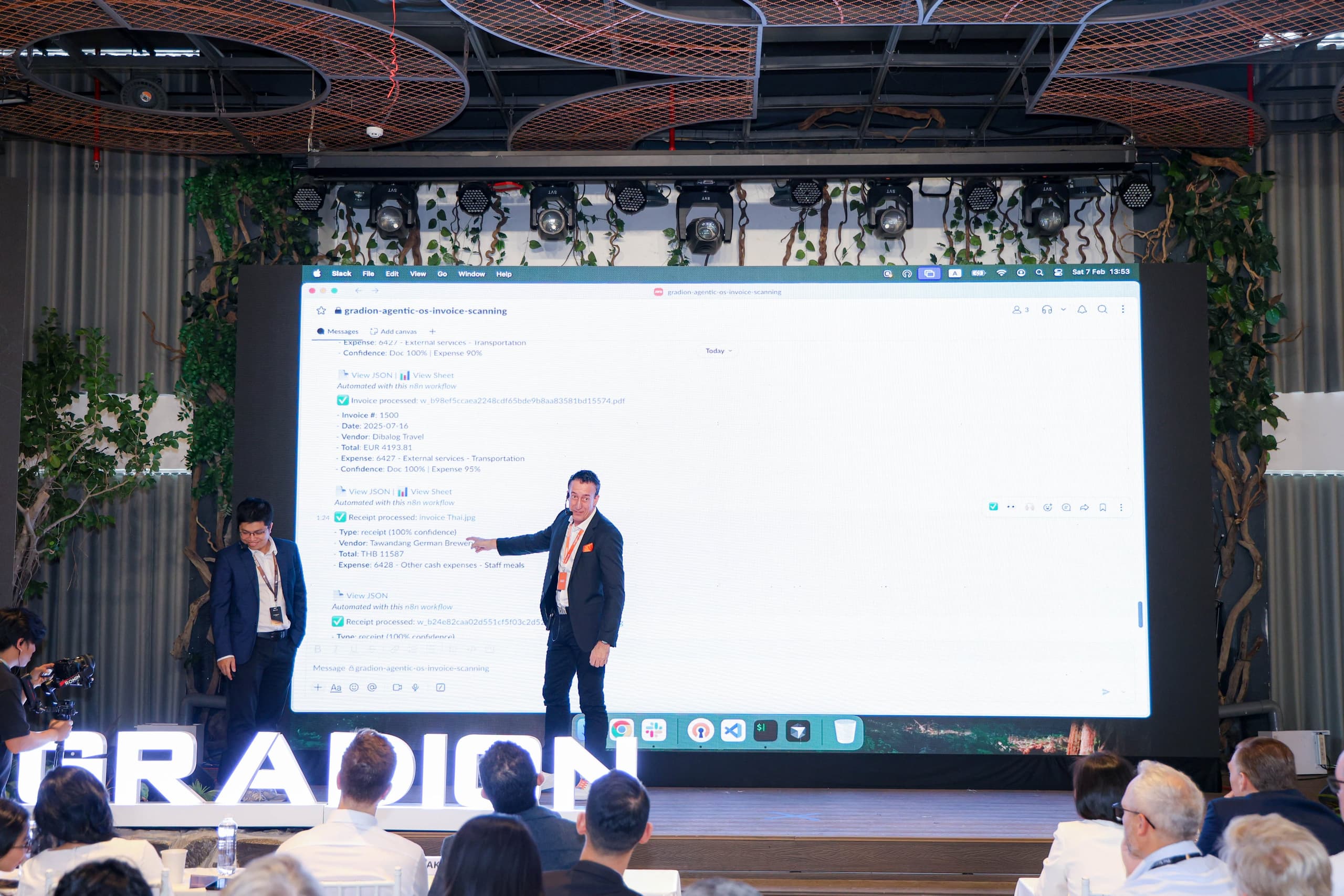
Dung Nguyen demonstrated the invoice extraction workflow live. Invoices land in a designated folder. The agent processes them, categorizes them, distinguishing invoices from receipts, handling Thai-language documents and posts results directly to a Slack channel and a Google Sheet. The finance team acts on the output. They don’t manage the process. Token cost: a few dollars per day.
Lesson 2: If you can’t name the exact problem the agent solves and the number that proves it works, you’re not ready to build it.
3. Replace Linear Costs With Nonlinear Ones
Growth used to mean headcount. More revenue required more people, which required more management, more training, more mistakes, more overhead. Every founder in the room knew the math.

Gradion’s talent acquisition team was receiving over 300 CVs per day. At seven minutes per CV, with five executives on the team, that was seven hours per person per day, just for the first step of the hiring process. They built a single agent that now handles 700 CVs per day. Adding capacity costs only additional token consumption from Gemini measured in dollars, not salaries.
Lars applied the same logic to the SaaS stack. Gradion spends over half a million euros per year on tools, HubSpot, Slack, Expensify, Lever, Google. For HubSpot alone, the bill is €47,000 a year, for roughly 5% of the functionality. “That’s at least two to three engineers for an entire year in Vietnam.” The plan: build their own CRM with AI, own the IP, and offer it to other companies.
“The key is that we decouple growth from cost. In the past, growth meant more people. Now we can grow without adding more headcount.”
Lesson 3: The shift from headcount to agents is not about cutting people, it’s about removing the ceiling on your growth.
4. Expect Cultural Resistance. Build Toward Excellence Anyway
The performance review case was the most honest part of the session. It didn’t go well at first.
Gradion implemented an AI-assisted 360-degree review: self-assessment, manager input, and a third evaluator, processed by AI to generate a clear and measurable performance output. Technically, it worked. Culturally, it collided with what Lars called the “favor economy.” “I scratch your back, you scratch my back. You give me a good review, I give you a good review.” The AI broke that system. Employees pushed back. The first version was too blunt. They learned, adjusted, and kept going.
Lars was clear about the broader implication: “We are building a culture of excellence, not a culture of comfort. We trade clarity and excellence for comfort and politeness.”
If employees aren’t willing to grow with AI or actively resist innovation, they shouldn’t stay. It sounds direct. It is also the honest position of every company that has made this transition work.
Lesson 4: Automation will break informal systems people relied on. That’s the point. Prepare your people or change your people.
5. Eat the Elephant One Bite at a Time
The final question from the audience was the most useful one: why do so many AI projects fail, and what does Gradion do differently?
The answer was simple. “Agentic projects are super small. They’re in one department. They tackle exactly one specific business problem.” Not a transformation program. Not everything at once. One pain point, two or three people, one measurable outcome. When it works, move to the next. This is how Gradion went from CV screening to invoice extraction to performance reviews to a planned CRM replacement not by mapping the full roadmap upfront, but by proving the model one agent at a time.
When a healthcare executive in the audience raised the challenge of fragmented data across sales, marketing, and point-of-sale systems, Lars gave the same answer. Start with the biggest pain. Connect the systems for that one problem. Solve it. Then repeat.
“How do you eat an elephant? Bite by bite. A lot of AI projects fail because they try to get the elephant in one go.”
Lesson 5: The companies that fail at AI try to boil the ocean. Pick the one thing that hurts the most and solve only that.
The CEO Execution Playbook: What to Do Tomorrow
- 1. Audit your data before anything else. List every system in your company that holds operational data. Identify where the same entity — employee, client, invoice — is described differently across systems. That gap is your real starting point.
- 2. Name one process with a measurable cost and a clear output. Find the task where you can say: it takes X minutes per unit, we process Y units per day. That is your first agent candidate.
- 3. Calculate what your SaaS stack actually costs per feature used. Run the number: what do you pay for tools you use at less than 20% capacity? That is your build-vs-buy opportunity.
- 4. Decide which feedback loop you’re willing to make objective. Pick one area — hiring, project delivery, client satisfaction — and commit to measuring it without political softening. Run the discomfort.
- 5. Choose one problem, assign two people, set a 30-day deadline. Do not try to connect everything. Solve the one thing that costs the most or blocks the most. Prove the model. Then scale it.
About the author
Rosie Nguyen
Rosie Nguyen works at the intersection of Marketing, Communications, and meaningful Storytelling at Gradion. She covers leadership and scaling, writing for the founders and operators building across Asia.
Something Land?
Lars and Dung built this system inside Gradion and now they build it for clients. If you want to explore where an agentic approach could work in your business, we're here to help.