
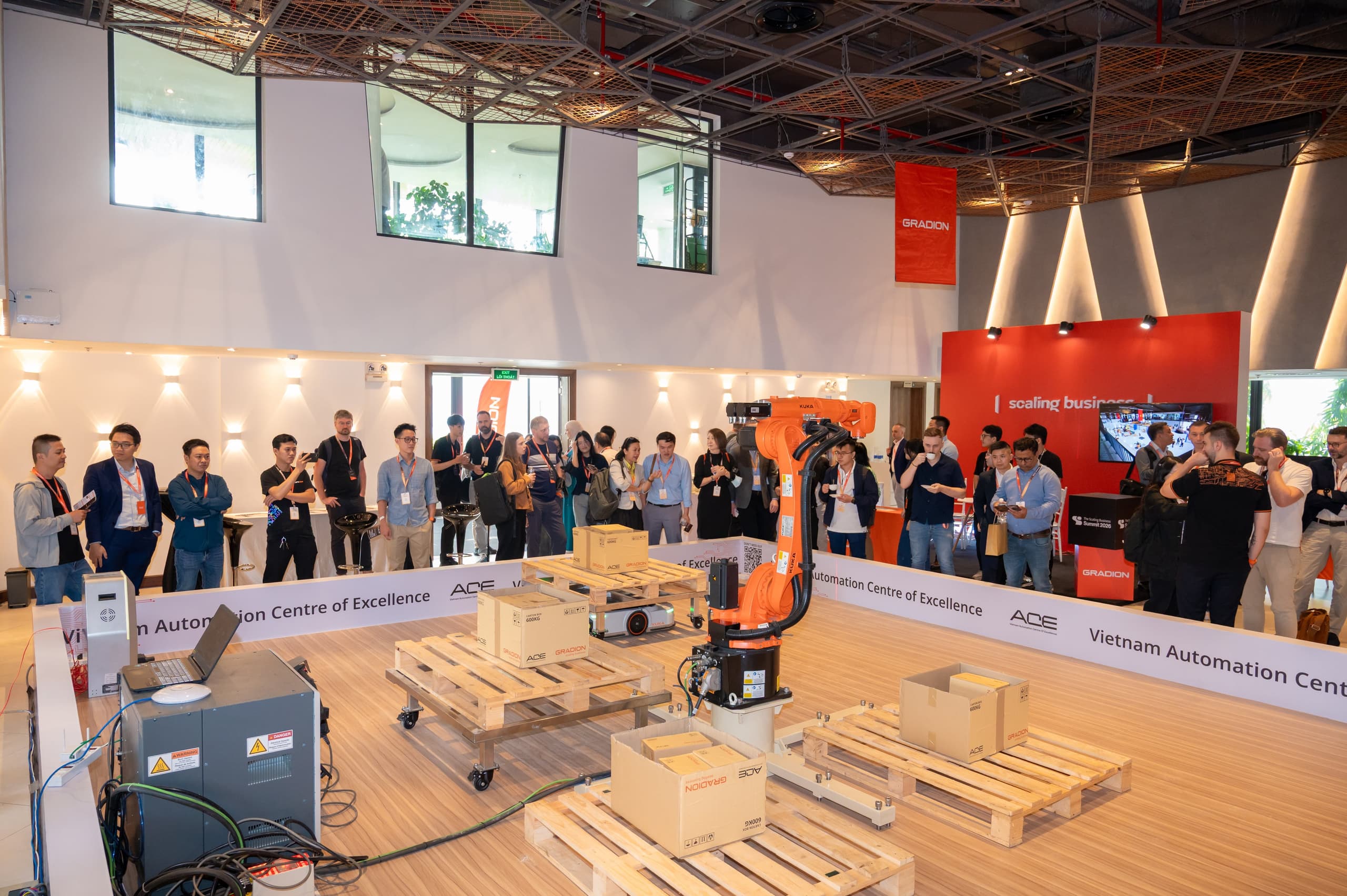
Vietnam's Robot Moment Has Arrived. Most Manufacturers Are Still Watching.

Rosie Nguyen
9 July 2026
Insights from the Scaling Business Summit 2026, Ho Chi Minh City.
Fifteen years ago, Huynh Phong Phu started his career as a sales engineer, selling industrial robots to Vietnamese manufacturers one by one. Today, as General Director of KUKA Vietnam, he watches that same market absorb over 2,600 robots per year and he knows that number is just the beginning.
In his keynote at the Scaling Business Summit, Phu presented a data-driven picture of where the global robotics industry stands, where Vietnam sits within it, and what is about to change. The session was structured around three lenses: the global landscape, Vietnam's current position, and the shift from hardware-first to software-first automation.
For any founder or executive in manufacturing, logistics, electronics, or industrial operations, this was a session about timing, specifically, about understanding which wave you are in and what the next one looks like.
1. The Industry That Defined Robotics for a Century Is No Longer the Biggest Buyer
For most of the 20th century, automotive was synonymous with industrial robotics. It justified the technology, funded the innovation, and built the mental model most manufacturers still carry.
That model is now outdated. Global industrial robot demand has more than doubled over the last decade from approximately 220,000 units annually to over 500,000 in 2024. But the growth did not come from automotive. It came from electronics.
As Phu noted, "automotive is shrinking in terms of robot demand, but electronics is growing faster to compensate for the overall growth of the entire robotics industry."
By 2024, automotive had fallen to 23% of the global robotics market. Electronics had taken the lead. For manufacturing leaders who still mentally categorize robotics as an automotive-sector tool, this is a material shift, not a footnote.
The implication extends beyond sector classification. It signals that the applications, form factors, and ROI models driving robot adoption have changed. The precision requirements of electronics manufacturing have pushed development toward speed, repeatability, and flexibility, all of which are now available to non-automotive buyers.
Lesson 1: If your mental model of industrial automation is built on the automotive industry, you're working from a decade-old map.
2. Vietnam Is 18th in the World and Two Inflection Points Explain Everything
Vietnam ranked 18th globally in robot shipments in 2024, with more than 2,600 units installed that year. Placed against the top five markets, China, Japan, the United States, South Korea, and Germany which together account for over 80% of global demand, Vietnam's position looks modest. But the trajectory tells a different story.
Two specific moments defined Vietnam's robotics decade. The first was 2017, when a major Korean electronics company widely understood to be Samsung made a large-scale investment in Vietnam and deployed thousands of robots in a single year. Phu, working at ABB at the time, personally helped supply over 3,000 to 4,000 units to that customer. That year became the single largest spike in Vietnam's robot installation history.
The second was 2018 and 2019, when VinFast entered as a domestic automotive manufacturer with significant automation investment. That sustained the momentum and anchored Vietnam's robotics market through the following years. Together, these two inflection points established the country's industrial automation baseline and raised the expectations of every manufacturer watching.

Electronics and automotive remain the two anchor industries. Metal processing and consumer goods manufacturing follow. The companies already automating in these sectors are the ones now accelerating their competitive advantage.
Lesson 2: Vietnam's robotics growth was not organic, it was catalyzed by two massive deployments. The next wave will come from the broader SME base, not just anchor manufacturers.
3. The Hardware War Is Over. The Software War Has Just Begun.
Industrial robotics is more than fifty years old. For most of that history, the competitive frontier was in hardware, better motors, higher payload capacity, greater precision, faster cycle times. KUKA itself holds several of the defining milestones: the world's first electrically driven robot in 1973, and the world's first robot capable of lifting one thousand kilograms, a payload ceiling that has since risen to 1.5 tonnes.
But Phu was direct about where the technology now stands: “Hardware technology has already reached maturity. Not much room for radical innovation or breakthrough technological development. The next wave of technology is starting to boom now.”
That next wave is AI, software, and digital platforms. Humanoid robot startups and AI-native automation companies are entering a market where the hardware problem is largely solved and competing on intelligence, adaptability, and ease of deployment instead. KUKA's response is iQKA, a software platform that consolidates engineering, operating system, and fleet management functions into a unified layer built on decades of robotics data.
The strategic logic is clear: whoever owns the software layer owns the ongoing relationship with the manufacturer. Hardware becomes a commodity. Intelligence becomes the product.
Lesson 3: The next competitive advantage in automation will not come from a better robot arm. It will come from better software, better data, and better AI. The hardware era is becoming the baseline.
4. The Cost Barrier Has Fallen. Automation Is No Longer a Large-Company Problem.
"Around five or six years ago, everyone was very concerned about ROI because of the cost of investment," Phu said. "Now the robot investment cost is significantly lower, and the barrier to adopt for small and medium companies has lowered."
This is not a minor adjustment. It is a structural shift in who can afford automation. The economic threshold that once excluded smaller manufacturers is no longer where it was. Companies that benchmarked automation costs three to five years ago and decided against it should revisit that analysis.
The collaborative robot (cobot) segment accelerates this further. Cobots designed to work alongside humans without safety caging have seen consistent double-digit growth over the last five years. The entry of multiple new players, particularly from China, has increased supply and compressed pricing across the category.
Lesson 4: The cost case against automation was valid in 2018. Running the same numbers today will produce a different answer.
5. The Workforce Gap Is the Next Bottleneck and Vietnam Is Starting to Close It
Installing a robot is only part of the challenge. The harder problem, and the one that limits adoption more than cost for many manufacturers, is the availability of engineers and technicians who can program, operate, and maintain automated systems. Vietnam's robotics ecosystem has grown faster than its talent supply.
KUKA's approach to this is structural rather than reactive. The Da Nang partnership with the University of Technology is designed to embed robotics education into the engineering curriculum in Vietnam's central industrial corridor, a region historically underserved by automation infrastructure. The Ho Chi Minh City center, co-located with the Saigon Hi-Tech Park training facility, is oriented toward developing the next generation of automation professionals in the south.
The broader implication is that the talent constraint is a solvable problem, but it requires investment at the ecosystem level, not just within individual companies. The manufacturers that invest in workforce development now, whether through internal programs or partnerships with technical institutions, will have a structural staffing advantage as automation penetrates further into the SME sector.
Phu's own trajectory underscores this point. Fifteen years of selling robots into the Vietnamese market gave him a ground-level picture of every bottleneck, cost, ROI skepticism, workforce readiness, and infrastructure gaps. That accumulated experience is now being used to dismantle each barrier, one region at a time.
Lesson 5: The robot is not the hard part. The engineer who operates it is. Build your automation talent pipeline now, before the shortage gets worse.
The CEO Execution Playbook: What to Do Tomorrow
- 1. Benchmark your automation density. Find out how many robots your industry peers are deploying per 10,000 workers, the IFR publishes this data by sector. If you are below the average for your industry, you are already behind the manufacturers you compete with on cost.
- 2. Revisit the ROI calculation. If the last time you evaluated automation costs was more than three years ago, the numbers have changed. Get a current quote. The floor on robot investment has moved significantly downward, and the ROI timeline has shortened.
- 3. Identify one repetitive, high-volume process. Palletizing, welding, assembly, quality inspection, pick the one task in your operation that happens thousands of times per week and requires no judgment. That is your first automation candidate. Start there.
- 4. Invest in one automation engineer this year. Not a vendor. Not a consultant. A person inside your organization who understands how automated systems work and can own the relationship with the technology long-term. The talent shortage is real. Hiring ahead of demand is cheaper than hiring after it.
- 5. Map the software layer. If you are already using robots, ask whether your machines are connected, whether you are collecting operational data, and whether anyone is analyzing it. The transition from hardware-first to software-first automation begins with knowing what your machines are telling you.
About the author
Rosie Nguyen
Rosie Nguyen works at the intersection of Marketing, Communications, and meaningful Storytelling at Gradion. She covers leadership and scaling, writing for the founders and operators building across Asia.
The Next Chapter of Vietnam Manufacturing Is Being Written Now.
One conversation with the right people can move faster than a year of internal deliberation.