
MES vs ERP: What Is the Difference and Do You Need Both?

Rosie Nguyen
27 August 2026
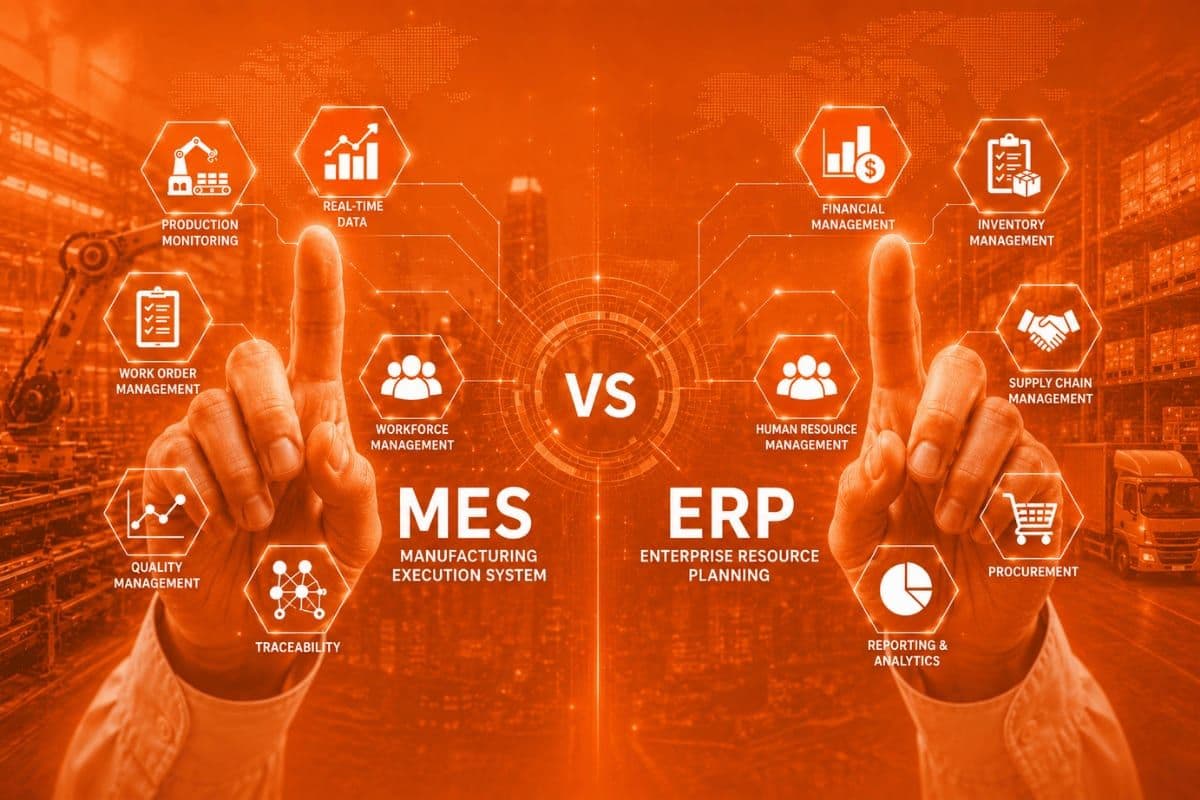
An ERP manages the business: finances, procurement, orders, and inventory at the enterprise level. An MES manages production: what is being made on the factory floor, on which machine, in what sequence, under what conditions, right now. Most manufacturers need both, because ERP data is too aggregated to control production and MES data is too granular to run the business. This article explains the difference, where each system operates, how they work together, and how to decide whether you need one or both.
What an ERP Does and Where It Operates
An Enterprise Resource Planning system manages the business functions that run above the factory floor: financial accounting, procurement, sales orders, inventory management, human resources, and supply chain planning. ERP data is transactional: it records what was ordered, what was received, what was shipped, and what it cost.
ERP systems operate on a planning horizon of days, weeks, and months. A production order in an ERP specifies what needs to be made and when it needs to be finished. It does not specify which machine should run it, in what sequence relative to other orders, at what speed, with what tooling, or under what quality parameters. That level of operational detail is outside the ERP's scope.
The limitations of ERP on the factory floor become visible when production managers are asked to report on what is happening right now. An ERP can report on what was planned and what was recorded as complete. It cannot report on what a machine is doing at this moment, what its current cycle time is, whether it is running to specification, or when it will finish the current order.
What an MES Does and Where It Operates
A Manufacturing Execution System manages production execution in real time. It receives production orders from the ERP and translates them into specific instructions for the factory floor: which machine runs which order, in what sequence, with what parameters, and what quality checks are required at each step.
MES data is operational and real-time: machine status, current cycle time, output count, defect count, operator, tooling, and process parameters, all captured at the moment of production. This is the data that allows a production manager to answer questions that ERP cannot: which orders are running behind, which machine has the highest defect rate today, and whether the current shift will finish on time.
What MES tracks that ERP does not
Production traceability at the lot and unit level: which material lot went into which finished unit, on which machine, at what time, under what process conditions. Quality data at the process step level: defect type, defect location, operator, machine, and shift. Machine performance data: cycle time, downtime events with cause codes, OEE by machine and shift. Labor data: which operator ran which order for how long. This is the data that global supply chain buyers increasingly require their suppliers to provide.
The Key Differences Between MES and ERP
Scope
ERP scope is enterprise-wide: it covers all business functions across the organization. MES scope is production-specific: it covers what happens between the release of a production order and the completion of a finished unit.
Data granularity
ERP data is aggregated: a production order is complete or incomplete, an inventory transaction occurred or did not. MES data is granular: the production order ran on machine 4, at 92 percent of design speed, produced 847 units with 12 defects of type B at station 3, and completed 14 minutes behind the planned cycle time.
Time horizon
ERP operates on a planning horizon: what needs to be made this week, this month, this quarter. MES operates in real time: what is being made right now, what happened in the last shift, and what will happen in the next four hours if current performance continues.
Decision support
ERP supports business decisions: procurement timing, production scheduling, financial reporting, customer order management. MES supports operational decisions: machine sequencing, quality intervention, maintenance scheduling, shift staffing, and real-time throughput management.
Do You Need Both MES and ERP?
Most manufacturers who operate at a scale where production traceability, quality management, and operational efficiency matter need both systems and need them integrated.
ERP without MES produces a factory that knows what it planned to make but not what it actually made, at what quality, on which equipment, or why performance deviated from the plan. The ERP receives completion records from the factory floor, but those records are manual entries that reflect what operators reported rather than what machines produced.
MES without ERP produces a production floor that is operationally visible but not connected to the business context that should drive its priorities: customer orders, material availability, financial constraints, and supply chain commitments.
Integration between the two is what produces operational and business alignment. The ERP releases a production order. The MES executes it, captures real-time production data, and reports completion back to the ERP with actual quantities, actual times, and actual quality results. The ERP updates inventory, triggers procurement, and updates customer delivery commitments based on what actually happened rather than what was planned.
When Manufacturers Can Start with MES Alone
Manufacturers who already have an ERP but need better production visibility should evaluate MES as the priority investment. The ERP is handling business functions adequately. What is missing is the real-time production data that MES provides: traceability, quality records, machine performance, and the operational visibility that global supply chain buyers require.
Manufacturers who do not yet have an ERP and are evaluating both simultaneously should prioritize MES if their primary problem is production floor visibility, quality management, or supply chain qualification. ERP handles business functions that can be managed manually at smaller production scales. MES addresses production floor problems that manual processes cannot solve at any scale.
FAQ
What is the difference between MES and ERP?
An ERP manages enterprise-wide business functions: finance, procurement, orders, and inventory at a planning level. An MES manages production execution in real time: what is being made on the factory floor right now, on which machine, in what sequence, with what quality results. ERP data is aggregated and transactional. MES data is granular and real-time.
Do manufacturers need both MES and ERP?
Most manufacturers operating at a scale where production traceability, quality management, and supply chain compliance matter need both systems integrated. ERP without MES produces a factory that knows what it planned but not what it made. MES without ERP produces a production floor disconnected from business priorities. Integration between the two aligns operational execution with business requirements.
What does an MES do that an ERP cannot?
An MES provides real-time production visibility: current machine status, cycle time, output count, defect rate by process step, and lot-level traceability connecting finished units to the specific materials, machines, operators, and process conditions involved in their production. ERP systems receive completion records from the production floor but do not capture or manage this level of operational detail.
What does an ERP do that an MES cannot?
An ERP manages the business context that should drive production priorities: customer orders, material procurement, financial accounting, supply chain commitments, and resource planning across the enterprise. MES operates within the production order that the ERP releases. Without ERP, the MES executes orders that are not connected to business commitments, inventory positions, or financial constraints.
When should a manufacturer implement MES before ERP?
Manufacturers who already have an ERP but lack production floor visibility should prioritize MES. Manufacturers who are choosing between the two should prioritize MES if their primary problems are production traceability, quality management, or supply chain qualification requirements from global buyers. ERP handles business functions that can be managed manually at smaller scales. MES addresses production floor problems that manual processes cannot solve.
How do MES and ERP integrate?
MES and ERP integration typically covers three data flows: production order release from ERP to MES, real-time production status from MES to ERP, and completion reporting from MES back to ERP with actual quantities, times, and quality results. Integration allows the ERP to update inventory, procurement, and customer delivery commitments based on what actually happened on the factory floor rather than what was planned.
About the author
Rosie Nguyen
Rosie Nguyen works at the intersection of Marketing, Communications, and meaningful Storytelling at Gradion. She covers leadership and scaling, writing for the founders and operators building across Asia.
Ready to close the gap between your factory floor and your business systems?
We help manufacturers assess, select, and integrate the production and business systems that fit their scale.