
Production Is Lean. The Logistics Feeding It Are Not.

Rosie Nguyen
23 June 2026
Insights from the Scaling Business Summit 2026, Ho Chi Minh City.
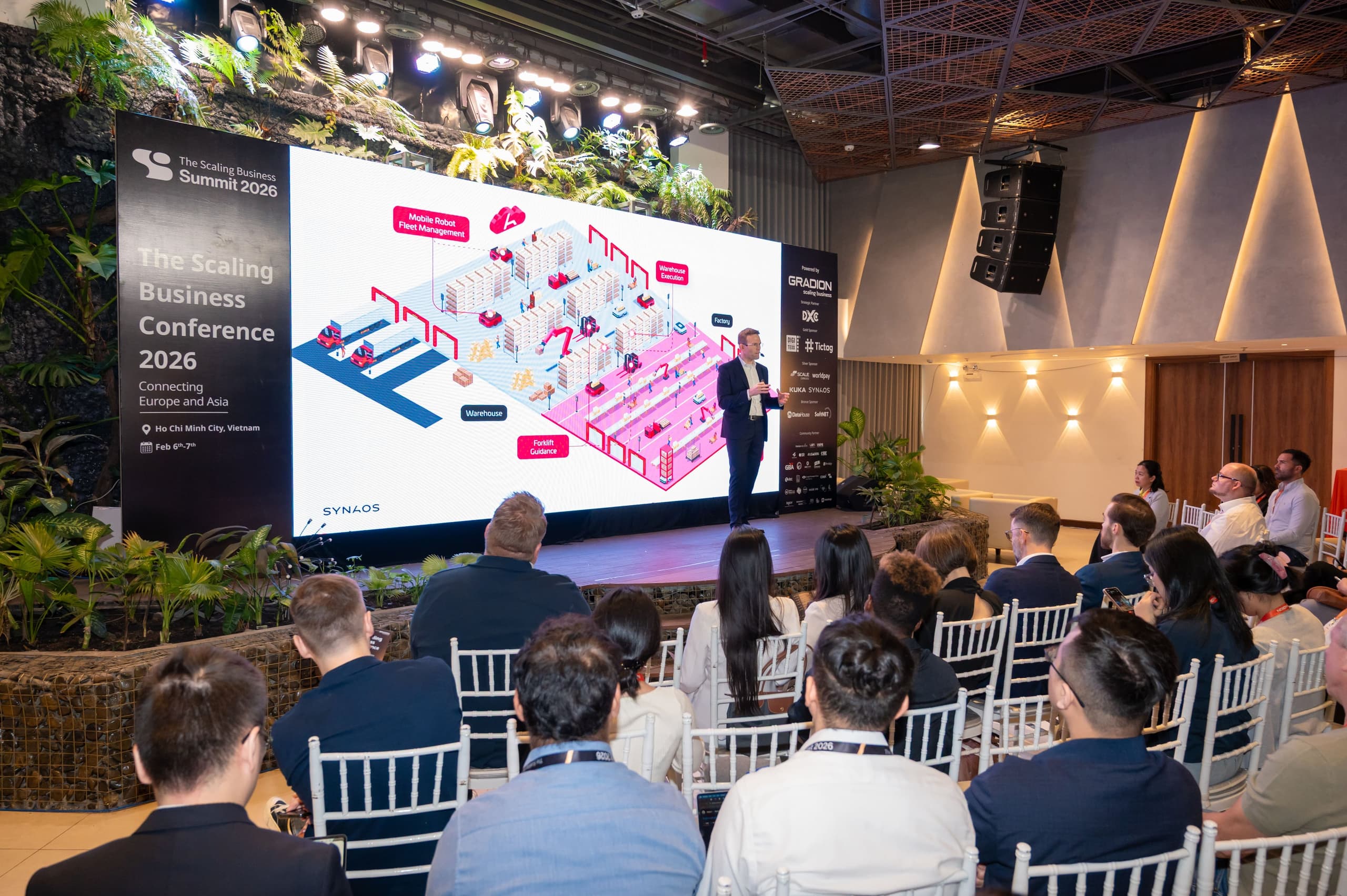
The SBS audience had spent two days hearing about AI, autonomous production, and the factory of the future. Dr. Philipp Schäfers, Head of Partnership at SYNAOS, opened his session with a forklift.
Not as a throwback. As a diagnosis. Because in most factories, the production line is the most optimized thing on the floor. The movement feeding it - the forklifts, the picking routes, the material flows between stations is often manual, untracked, and leaking efficiency that nobody has measured.
SYNAOS builds the orchestration software that manages this. Founded in Hanover in 2018, the company connects manual forklifts, mobile robots, and mixed fleets under one intelligent platform serving customers from Volkswagen and Schaeffler to food and beverage manufacturers. In Asia, they operate through their partner Gradion. What Philipp laid out was the journey from forklift to fleet intelligence, and the specific choices that determine whether automation scales or stalls.
1. The Factory's Biggest Optimization Blind Spot
Production processes in most manufacturing facilities are intensively managed. Lean teams map waste. Industrial engineers balance workloads. Every second of cycle time is contested. The optimization discipline is real and the results show it.
Then the finished part leaves the production cell. And the forklift takes over.
“Often in intralogistics, there's no optimization. The processes are very manual. Also, order processing is very manual. That's why we see a huge potential to optimize those processes and make them more efficient.”

The gap is structural. Production optimization has decades of methodology behind it, lean, Six Sigma, Theory of Constraints. Intralogistics optimization has largely been managed by experience and intuition: a driver who knows the shortcuts, a supervisor who watches the floor, a planner who builds schedules in a spreadsheet.
Philipp offered a specific example. A plant director was standing on the floor watching his forklift drivers and noticed they were driving empty far more than they should. He suspected it but had no data to confirm it, no baseline to improve from, no visibility into how routes were actually being run. “He really didn't have transparency about the efficiency of his manual intralogistics processes.” That transparency gap, invisible because no one had instrumented it, is where most factories are leaving the most efficiency on the table.
Lesson 1: Production is optimized because someone chose to measure it. Intralogistics is inefficient for the same reason. The gap between what you assume is happening and what is actually happening starts with a sensor.
2. The Automation Museum Problem
Many factories have started automation pilots. A mobile robot moves parts between two stations. It works. The pilot report looks good. And then it stops there. One robot. Maybe two. Running the same loop for years.
Philipp named this pattern directly. “You will be stuck having maybe one robot or two robots driving around and then it ends up in kind of an automation museum.” Not because the technology failed. Because the early decisions made scaling impossible.
The most common failure point is software lock-in. A factory buys a mobile robot from one vendor. That robot comes with the vendor's proprietary fleet management system. It works for that robot. When the factory wants a second robot from a different vendor because it needs a different vehicle type, or the first vendor can't supply fast enough, the two systems cannot talk to each other. The fleet cannot be managed as a fleet. Each robot operates in isolation.
The solution is not to commit to a single robot vendor. It is to commit to a platform that is vendor-independent from the start.
“It's important to make the right decisions right at the beginning. Otherwise you will never get to the point of scaling automation.”
That means choosing orchestration software that can accommodate multiple robot types, multiple vendors, and an evolving mix of manual and automated transport before the fleet is large enough to make switching expensive.
Lesson 2: The automation pilot is easy. The scaling decision happens at the software layer, before the second robot. Choose vendor-independent orchestration from the start or accept that your automation stays a museum exhibit.
3. Your Fleet Will Be Diverse. Plan for It Now.
At scale, no manufacturer runs a single-vendor robot fleet. Operating 50 sites or 100 sites globally means different procurement decisions, different vehicle requirements for different floor types, different suppliers in different regions. The multi-vendor fleet is not an edge case. It is the default at enterprise scale.
The challenge this creates is communication. Robots from different manufacturers speak different protocols. A tow tractor from one vendor and an AMR from another have no shared language for exchanging positions, accepting orders, or handling errors unless a standard imposes one.
VDA 5050 is that standard. Developed by the German automotive and machine-building associations, it defines a universal communication interface between mobile robots and fleet management systems. It is technology-independent: the same protocol works for an AMR, an AGV, a forklift AGV, or an automated tow train. SYNAOS has been part of the working group since the standard's inception and uses it as the integration layer for all connected robots.
The standard also handles the operational complexity of mixed-fleet environments. Local safety decisions, stopping when a person steps in front of the robot, stay on the robot's onboard system. Central optimization and order assignment run in the cloud. The architecture separates what must be local from what is better centralized, and the protocol manages the handoff between them.
Lesson 3: Multi-vendor fleets are inevitable at scale. Design your integration architecture around an open standard now so you can add the third and fourth vendor without rebuilding from scratch.
4. Start with the Forklift, Not the Robot
The counterintuitive entry point for factory automation is not buying a robot. It is instrumenting what you already have.
SYNAOS's first product in the automation journey is real-time localization for manual vehicles: a small camera-based sensor kit mounted on an existing forklift that transmits its position continuously. The forklift stays manual. The driver still drives. But for the first time, the system can see where the forklift goes, how long it spends at each station, how much of its travel is loaded versus empty, and where the bottlenecks in the flow actually are.
The second step is forklift guidance: an app that gives the driver instructions on what to pick up next and where to go, sequenced by the same optimization engine that will later manage the robot fleet. The driver's judgment is replaced by system intelligence on order sequencing, but the vehicle remains human-operated.
Both steps produce something more valuable than efficiency gains: they produce data. The data reveals the actual material flows in the factory not the assumed flows from the design documents, but the real ones. That reality becomes the basis for every automation decision that follows. Where do robots make sense? Which routes have sufficient volume to justify automation? Where do manual and automated flows need to coexist?
Lesson 4: Visibility precedes automation. The data from instrumenting your manual processes is worth more than the first robot. It tells you where to put the robot.
5. Software Is the Intelligence. Cloud Is the Scale.
The future Philipp described is one where the orchestration intelligence is cleanly separated from the hardware it manages. Robots carry their own onboard software for navigation, safety, and local decision-making. A cloud platform handles everything above that: order assignment, route optimization, traffic management, charging coordination, and real-time replanning when conditions change.
The cloud layer calculates continuously. “We are calculating 200 to 300,000 solutions per second to reach this goal” comparing all pending transport orders against all available resources, every time a new event occurs. A robot stops unexpectedly. A new order arrives. A door is blocked. The plan is recalculated in real time, not the next morning when someone exports an Excel report.
This is the gap most factories currently live in. The data exists. The systems generate it. But a person sits between the data and the decision, doing manual analysis that could be automated. The optimization the software performs continuously in milliseconds takes the analyst hours and produces a plan that is already outdated when it is implemented.
The cloud architecture also enables the enterprise rollout that justifies the investment. The same platform running in one factory can extend to ten, fifty, or a hundred sites without a proportional increase in software cost or management overhead. That is where the return compounds.
Lesson 5: The efficiency case for intralogistics software is real-time continuous optimization. The business case is enterprise scale. Both require a cloud architecture.
The CEO Execution Playbook: What to Do Tomorrow
- 1. Put a sensor on one forklift this quarter. Before any robot discussion, get real-time visibility into how your manual intralogistics actually operates. The data will either confirm your assumptions or correct them. Either outcome is worth having.
- 2. Map your empty-driving ratio. Once you have localization data, calculate the percentage of forklift travel that is empty. In most unoptimized operations, this number is surprisingly high. It is your first baseline for improvement.
- 3. Audit your current automation software for vendor lock-in. If your existing robot management system only works with one vendor's hardware, you already have a scaling ceiling. Understand where that ceiling is before your next robot procurement.
- 4. Check VDA 5050 compliance on your next robot purchase. Before signing any new mobile robot contract, confirm the vendor supports VDA 5050. It is the difference between adding a robot to your fleet and adding a robot to your museum.
- 5. Define your intralogistics scaling target before the pilot. How many robots do you ultimately want running in this facility? Design the software architecture for that number, not for the first one. The pilot is cheap to restart. The architecture is not.
About the author
Rosie Nguyen
Rosie Nguyen works at the intersection of Marketing, Communications, and meaningful Storytelling at Gradion. She covers leadership and scaling, writing for the founders and operators building across Asia.
Your Intralogistics Has an Intelligence Gap.
Gradion brings SYNAOS fleet orchestration to Asia Pacific. Let's talk about what that looks like in your facility.