
Collaborative Robots in Vietnamese Manufacturing: The Business Case in Numbers

Rosie Nguyen
11 August 2026
Collaborative robots deliver a positive ROI for Vietnamese manufacturers when deployed on the right tasks: repetitive operations, high-turnover positions, or variable-volume production lines. In well-matched applications, payback periods in comparable ASEAN manufacturing environments run 12 to 24 months. In poorly matched ones, the robot sits idle and the business case never closes.
The question is not whether cobots work. It is whether they work for your specific operation.
What makes cobots different from industrial robots
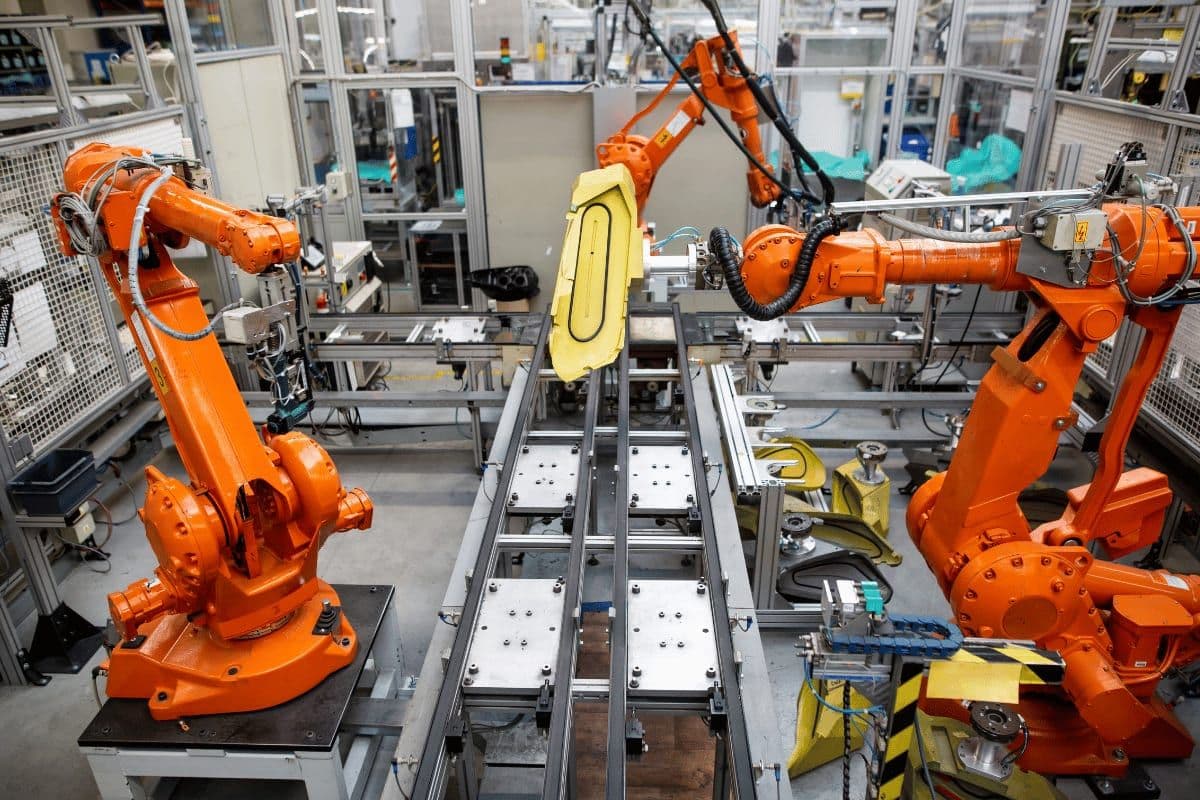
Traditional industrial robots are fast, precise, and fixed. They require safety caging, dedicated floor space, and significant integration work. Changing what they do requires reprogramming and often mechanical reconfiguration.
Collaborative robots are designed to work alongside people without safety barriers. They are lighter, easier to redeploy, and can be set up in hours rather than weeks. They trade peak speed for flexibility.
For Vietnamese manufacturers running mixed product lines or frequent changeovers, that flexibility has direct value.
Where cobots deliver in Vietnamese manufacturing
Three application categories consistently produce measurable results.
Quality inspection and testing
Cobots perform visual or dimensional inspection at consistent speed and accuracy. They do not fatigue, do not miss a shift, and produce a data record for every unit checked. For manufacturers supplying DACH or Japanese buyers with strict quality requirements, this is a concrete differentiator.
Assembly and sub-assembly
Repetitive assembly tasks with defined sequences are a strong fit. A cobot working a single station operates a full shift without variation. The business case strengthens when the task involves components that are physically demanding or ergonomically problematic for human workers over time.
Machine tending
Loading and unloading CNC machines, injection molding equipment, or stamping presses is one of the most common cobot deployments in Vietnamese manufacturing. The task is repetitive, the cycle time is predictable, and the cobot frees the operator for higher-value work.
The business case: what drives ROI
Three factors determine whether the cobot ROI calculation closes.
Utilization rate
A cobot running two shifts delivers roughly twice the value of one running a single shift. Most manufacturers underestimate how much utilization rate affects the payback period. The fixed cost is the same whether the robot runs 60% or 100% of available time. Design your deployment around maximizing utilization before committing to hardware.
Labor cost differential
Vietnamese labor costs are rising. The cobot business case that did not work three years ago may work today. The relevant comparison is not just the current wage but the fully loaded cost: recruitment, training, turnover, and management overhead on a position with consistent attrition.
Changeover frequency
If your production line runs the same product for months at a time, a traditional industrial robot may deliver better throughput at lower cost. If you change products weekly or run small batches, the cobot's reprogrammability is where it earns its value.
Cobot vs industrial robot: when to choose which
Collaborative robot: no safety barrier required, payload up to ~35 kg, lower operating speed, setup in hours, operator-level reprogramming. Best for flexible, mixed-volume lines.
Industrial robot: safety barrier required, payload up to 2,000+ kg, higher operating speed, setup in days to weeks, engineer-level reprogramming. Best for high-volume, fixed processes.
Choose a cobot when flexibility matters more than throughput. Choose an industrial robot when throughput is the primary requirement and the process is stable.
Four things to verify before investing
1. Is the task well-defined?
Cobots perform best on tasks with clear, repeatable steps. Unstructured tasks, variable inputs, or processes requiring judgment are not a good fit for current cobot technology.
2. Is the floor ready?
Cobots require stable mounting, appropriate power supply, and a defined safety zone even without full caging. A floor readiness assessment before purchase prevents costly installation delays.
3. Who will own it internally?
Most cobot vendors offer operator-level programming interfaces. But someone on your team needs to be accountable for the cobot. Deployments without a designated internal owner consistently underperform.
4. What does the full cost include?
The hardware price is one line item. Add end-of-arm tooling, integration, safety assessment, operator training, and a maintenance contract. Total deployment cost typically runs 1.5 to 2 times the hardware price. Build this into the business case from the start.
FAQ
Are collaborative robots worth the investment for Vietnamese manufacturers?
Yes, in the right application. Cobots deliver measurable ROI on repetitive, high-turnover, or variable-volume tasks where flexibility matters. The business case depends on utilization rate, labor cost differential, and changeover frequency. Not just the hardware price.
What is the payback period for a cobot in Vietnamese manufacturing?
In well-matched applications, payback periods in comparable ASEAN manufacturing environments typically run 12 to 24 months. Poorly matched deployments extend this significantly or fail to reach payback at all. Application fit is the primary variable, not brand or model.
How much does a collaborative robot cost to deploy in Vietnam?
Entry-level cobots from established vendors start at approximately $20,000 to $35,000 USD for the robot unit. Total deployment cost including tooling, integration, and training typically runs 1.5 to 2 times the hardware price. Multi-robot deployments reduce the per-unit integration cost.
What is the difference between a cobot and an industrial robot?
Industrial robots are designed for high-speed, high-payload, fixed-process applications and require safety caging. Collaborative robots work alongside people, are easier to redeploy, and can be reprogrammed at the operator level. The right choice depends on whether throughput or flexibility is the primary requirement for your operation. There is no universal answer.
What tasks are cobots best suited for in Vietnamese manufacturing?
The strongest applications are machine tending, repetitive assembly, and quality inspection. These share defined sequences, predictable cycle times, and high operator turnover rates. Tasks requiring judgment, variable inputs, or heavy payloads are better suited to other automation approaches.
How does cobot ROI change as Vietnamese labor costs rise?
Rising labor costs improve the cobot ROI calculation directly. The hardware cost is fixed. The labor cost savings the cobot generates increase as wages rise. Manufacturers who evaluated cobots and did not make the business case two or three years ago should recalculate with current labor cost data before deciding.
About the author
Rosie Nguyen
Rosie Nguyen works at the intersection of Marketing, Communications, and meaningful Storytelling at Gradion. She covers leadership and scaling, writing for the founders and operators building across Asia.
Not sure if cobots pay off on your line?
We help Vietnamese manufacturers assess task fit, utilization, and labor cost differential to determine whether the cobot business case closes.