
IoT Is Not a Technology Problem. It Is a Data Quality Problem.

Rosie Nguyen
14 July 2026
Insights from the Scaling Business Summit 2026, Ho Chi Minh City.
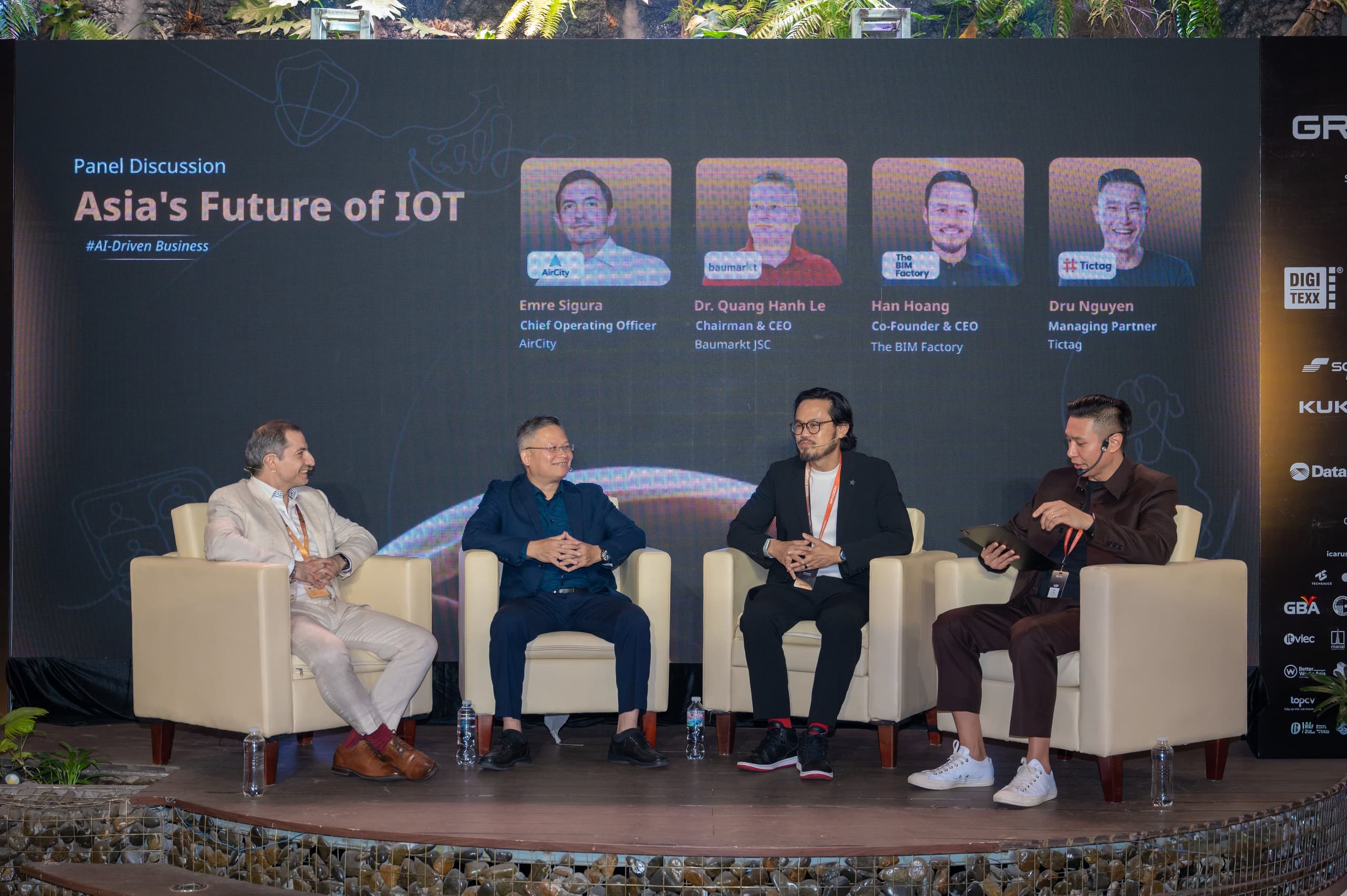
The panel on Asia's future of IoT brought together three operators from opposite ends of the built environment, a building management company running 80 properties in Saigon, the founder of Vietnam's first AI-powered furniture ecosystem, and the man who introduced building information modeling to the country fifteen years ago. The moderator, Dru Nguyen of Tictag, opened by admitting he had looked up the definition of IoT before the session.
What followed was one of the more grounded conversations of the Summit, three people who had spent years colliding with the gap between IoT's promise and its reality, comparing notes on what actually works, what traps companies fall into, and why the technology problem is almost never the real problem.
1. IoT Is Not a Technology Showcase. It Is a Unit Economic Enforcer.
Emre Sigura, COO of AirCity, manages 80 buildings in Ho Chi Minh City, 90% of them old. His first framing of IoT was deliberately unglamorous: forget the drone deliveries and flying lattes. What IoT actually does, in practice, is create process.
“IoT is the one that creates the process for us. How we scale is because we scale back with the human resources, we decouple the operations between headcount and operations, just to cut costs.”

The operational logic is straightforward. Instead of waiting for a 20-year-old elevator to break down during the morning rush hour, sensors feed into a predictive maintenance dashboard that triggers servicing before the failure happens. Reactive becomes proactive. Headcount stays flat while coverage scales.
The business model consequence of this is significant. A building that previously required 50 security guards might need considerably fewer once sensors, digital locks, and automated monitoring are in place. The initial deployment cost is real, typically not five thousand dollars but five hundred thousand, but the savings compound against the headcount line every month. Emre's framing: the trade-off is not IoT versus no IoT. It is upfront capital versus sustained operational cost.
He described the architecture simply: “IoT is the nervous system. AI is the brains. And then the human part kicks in which we have already shrunk down to what is actually necessary.” The human role becomes judgment and escalation, not surveillance and manual checking.
Lesson 1: IoT's business case is not in the technology. It is in the labor economics. If you cannot model how it decouples headcount from operational output, the investment will not justify itself.
2. Data Without Context Is Just Noise. BIM Is What Makes IoT Intelligent
Han Hoang, Co-Founder and CEO of The BIM Factory, offered the clearest conceptual frame of the panel. IoT and BIM operate at different stages of the same process, and conflating them or deploying one without the other is why so many smart building projects disappoint.
"IoT is data. BIM is what makes the data intelligent. BIM puts the data into context."

A sensor can tell you an elevator is drawing unusual power. BIM tells you which elevator, which floor, what its maintenance history is, when it was last serviced, and what parts are likely involved. Without that context, the signal is noise. With it, the signal becomes a work order.
Han illustrated this with a light bulb. Without structured data: tenant calls, maintenance responds, visits, identifies the part, leaves to buy it, returns and installs potentially four separate trips across several days. With structured data: maintenance sees the exact location, the fixture specification, the warranty status, and the correct ladder height before leaving the office. One trip. Ten minutes.
The same principle applies to anything connected. Han was pointed about what happens when data is added without structure: "If you have not well-structured data and you're putting just data in, it becomes dumb. Be careful with what you put in, garbage in, garbage out."
Lesson 2: Smart devices without structured data are expensive sensors with nowhere to send the signal. The intelligence in a smart building lives in how the data is organized, not how much of it you collect.
3. The Integration Trap: Most Buildings Are Already Stuck In It
Emre introduced a term that resonated throughout the panel: the integration trap. It describes what happens when a building owner has already purchased an IoT solution, typically expensive, typically sold by a vendor who prioritized the demo over the deployment and is now managing infrastructure that does not work well, cannot be easily extended, and costs too much to replace.
"There's always a trust issue in the market. The integration trap is not something that should be thrown out but it should be negotiated with someone who is a capable service company or operations company that can really handle it."
Navigating the trap requires a specific approach: start with an audit of what is already installed, identify what is genuinely working versus what performed on a demo and failed in operations, then build toward a dashboard the operations team actually uses every day not the most visually impressive one, but one that changes decisions.
The trap also has a timing dimension. Buildings that are already occupied and operational, brownfield projects, face a fundamental constraint: every change to infrastructure requires working around tenants, existing systems, and legacy vendor relationships. The cost of retrofitting is not just financial. It is organizational.
Emre was frank about the gap between the pitch and the reality: "Demo day is perfect. Everything is crystal clear. Everyone is smiling. There is this wow effect. But the 100-day mark kicks in and then everyone is in firefight."
Lesson 3: The integration trap is the most common reason IoT projects fail after deployment. Evaluate the operations model before the technology. The technology is almost never the hard part.
4. Plan IoT into the Design Phase or Pay Three to Five Times More Later
One of Han's most actionable contributions to the panel was a straightforward economic point: the cost of integrating IoT into a project scales dramatically depending on when the decision is made. Designed in at the beginning, it is a line item. Retrofitted after construction, it is a reconstruction project.
“When you plan IoT into the design phase, it actually saves money. When you plan IoT at later stages, it costs three to five times more than the actual cost.” The reason is compounding complexity. Wiring, structural access, system integration, coordination with multiple contractors, all of these are straightforward during construction and extremely disruptive after occupancy.
This applies equally to commercial developments, residential projects, and industrial facilities. The impulse to defer the IoT decision until the building is closer to completion is understandable, budgets are under pressure, timelines are constrained but it consistently produces the most expensive outcomes.
Dr. Quang Hanh Le of Baumarkt extended this thinking into furniture and interiors. His company's AI house doctor platform designs, produces, and manages furniture through a connected lifecycle, monitoring condition, triggering maintenance, facilitating buyback, and eventually routing materials into refurbishment or 3D printing when the product reaches end of life. The IoT layer in this model is not an add-on. It is structural to the circular economy logic the business is built on.

Lesson 4: IoT planned early is infrastructure. IoT planned late is renovation. The decision point is at design not at handover.
5. The Trust Gap Is the Real Adoption Barrier — and Transparency Is What Closes It
Han spent fifteen years pushing BIM adoption in Vietnam before the government mandated it. He presented the model of the Hai Ba Trung tunnel as a proof of concept in the early 2010s, detailed data showing the time and cost that could have been saved. The senior official's response was to tell him to go back to America.
The resistance was not ignorance. It was incentive alignment. As Han put it directly: the moment a project becomes fully transparent, every ton of cement, every sensor placement, every cost item, certain revenue streams that had previously operated in the shadows disappear. “Where's my kickback? Where's my commission? That is one of the biggest reasons there is a lot of hesitation.”
Vietnam mandated BIM for infrastructure projects in 2024. Private buildings over 5,000 square meters will follow in the next phase. The shift took a decade from Singapore's 2014 mandate, but it is now embedded in law, precisely because transparency, once mandated, produces better procurement outcomes and attracts FDI that requires audit-grade project data.
Emre connected this to the generational shift he sees in property management. The change is not about old industry versus new technology. “It's the mentality. It's the mindset. And the newer generation, the comebacks, the overseas Vietnamese coming back not to teach them a lesson, but to progress with them.”
The trust framework Emre articulated has three steps: transparency creates trust, trust reduces friction, friction reduction enables transactions. Smart buildings, BIM-enabled procurement, and connected furniture ecosystems are all, at their core, friction reduction plays built on a foundation of reliable data.
Lesson 5: Technology adoption in Asia's built environment is not blocked by capability. It is blocked by trust. Build the transparency layer first, the technology follows.
The CEO Execution Playbook: What to Do Tomorrow
- 1. Audit your current IoT assets for context. List every sensor, device, or connected system in your operation. Ask whether the data from each one is connected to structured information, asset specs, maintenance history, ownership, location. If the data is disconnected, you have sensors, not intelligence.
- 2. Model the headcount decoupling. For any operations function in your business, map how many people are doing what manually. Then ask: which of these tasks could be automated with sensors and a dashboard? Quantify the labor cost. That is your IoT business case, not the technology, the savings.
- 3. Identify your integration trap exposure. If you have previously purchased IoT or building management technology, assess honestly whether it is working. Is the dashboard used daily? Has it changed any operational decision in the last 90 days? If not, the trap is already closed. Address it before adding more technology on top.
- 4. Plan your next project's data architecture before the construction drawings. If you are building, renovating, or commissioning any physical environment in the next 12 months, require the IoT and connectivity plan to be completed before schematic design is finished. The cost multiplier for retrofitting is real and documented.
- 5. Define the transparency layer for one internal process. Pick one procurement or operational process where trust or verification is a friction point. Design a data trail for it, not necessarily a full platform, just a structured record that external parties can audit. That is how trust gets built: one verifiable process at a time.
About the author
Rosie Nguyen
Rosie Nguyen works at the intersection of Marketing, Communications, and meaningful Storytelling at Gradion. She covers leadership and scaling, writing for the founders and operators building across Asia.
Something Land?
One honest conversation moves faster than another internal report. Gradion works with operators navigating exactly this shift.