
AGV Floor Layout: How to Design Your Factory for Autonomous Mobile Robots

Rosie Nguyen
21 August 2026
Technical insights in this article were validated by Liam Nguyen, Senior Automation Engineer / Team Lead at Gradion.
Manufacturers who address factory floor conditions before vehicle selection deploy AGVs faster. They also avoid the retrofits that account for most first-deployment underperformance. Five conditions in Vietnamese manufacturing consistently drive that gap: shopfloor density, vertical infrastructure barriers, floor surface quality, WiFi coverage, and charging and maintenance space. Each one affects what any vehicle can deliver, regardless of specification. This guide covers what each condition looks like and how to design for it.
Why floor layout is the AGV decision most manufacturers get wrong
Most AGV deployments in Vietnamese manufacturing fail not because the vehicle is wrong, but because the floor was never designed for it. The layout came first , built up over years, shaped by seasonal demand shifts and step-by-step capacity additions , and the AGV is asked to operate inside constraints that were never part of the original plan.
Five of those constraints appear consistently across Vietnamese manufacturing floors.
High-density and scattered shopfloor layouts
Most mid-market manufacturing floors in Vietnam were not designed from a master layout. They grew. Each production line was added where space was available. Equipment was repositioned for seasonal orders. High-mix low-volume production created irregular cell arrangements that do not conform to the clear, consistent aisles AGVs require.
The result is a floor that looks occupied and functional but has no reliable path structure. An AGV route that works today may be blocked tomorrow by a repositioned rack, a seasonal workstation, or a batch of raw materials waiting for a free storage location.
Infrastructure constraints in vertically scaled facilities
Manufacturers who have scaled vertically face a category of AGV integration challenge that flat facilities do not: fixed infrastructure elements that AGVs cannot pass through or interact with reliably.
Elevators, fire stop doors, and PVC strip curtains are standard in multi-floor or partitioned Vietnamese factories. Each one is a potential AGV barrier. Integrating AGV movement across these elements requires hardware modification, software triggers, and coordination with facility management systems. Manufacturers who do not account for these constraints at the layout stage discover them after the vehicle is already on order.
Floor quality
Factory floors in Vietnamese manufacturing environments have rarely been maintained as precision surfaces. Years of forklift operation, high ambient humidity, and industrial cleaning chemicals leave floors with surface variations, cracks, and contamination that AGV navigation systems struggle with.
AGVs require consistent floor surfaces to maintain positioning accuracy and move reliably at operating speed. A floor that a forklift driver can navigate by visual correction is not necessarily a floor an AGV can traverse without repeated stops, drift corrections, or positioning failures. Floor condition is an AGV readiness factor that most manufacturers do not assess until the first installation reveals the problem.
Network blackouts and ghost stops
Dense equipment layouts and metal structures create WiFi dead zones across the factory floor. An AGV operating in a dead zone loses network contact, stops without apparent mechanical cause, and holds up every vehicle behind it in the route sequence. Operators call these ghost stops: the vehicle appears to be working but is not moving.
Ghost stops are not an AGV malfunction. They are a network coverage failure that becomes visible through AGV behavior. In a factory where WiFi has always been adequate for handheld scanners and office connectivity, the localized dead zones created by dense equipment do not surface until an AGV tries to navigate through them continuously.
Charging, parking, and maintenance space
In most Vietnamese factories, the space assigned to AGV charging, parking, and maintenance is a corner of the floor where other equipment does not fit. This approach treats AGV infrastructure as a residual use of leftover space rather than a planned operational requirement.
A charging bay positioned in a corner that requires vehicles to detour significantly from their operating routes reduces fleet utilization. A maintenance zone that does not allow multi-side access to the vehicle increases service time. A parking area that does not account for queue sequencing creates congestion at shift start. Each of these is a layout decision that limits what the fleet can deliver, regardless of the vehicle's rated performance.
Traffic management and routing
An AGV floor layout defines the physical infrastructure. Traffic management defines how vehicles use it.
Three decisions affect layout design directly.
Unidirectional versus bidirectional routing. Unidirectional routes require more floor space but eliminate head-on conflict management. Bidirectional routes use less space but require passing bays, speed management, and conflict resolution logic in the FMS. The choice affects both aisle width requirements and FMS complexity.
Intersection management. Every intersection between AGV routes is a potential conflict point. Layouts that minimize intersections through logical route design reduce FMS load and improve throughput predictability. Intersections that cannot be eliminated need defined right-of-way rules built into FMS routing logic.
Maintenance stop zones. Every AGV path needs defined areas where a vehicle can stop safely without blocking critical routes or creating secondary hazards. Emergency stop zone requirements affect aisle length calculations and staging area design.
Common AGV layout mistakes: how to address them
The five conditions above are not reasons to defer AGV deployment. Each one has a practical solution. The manufacturers who deploy successfully address these constraints at the layout and specification stage rather than discovering them after commissioning.
No separation between human production zones and AGV travel paths
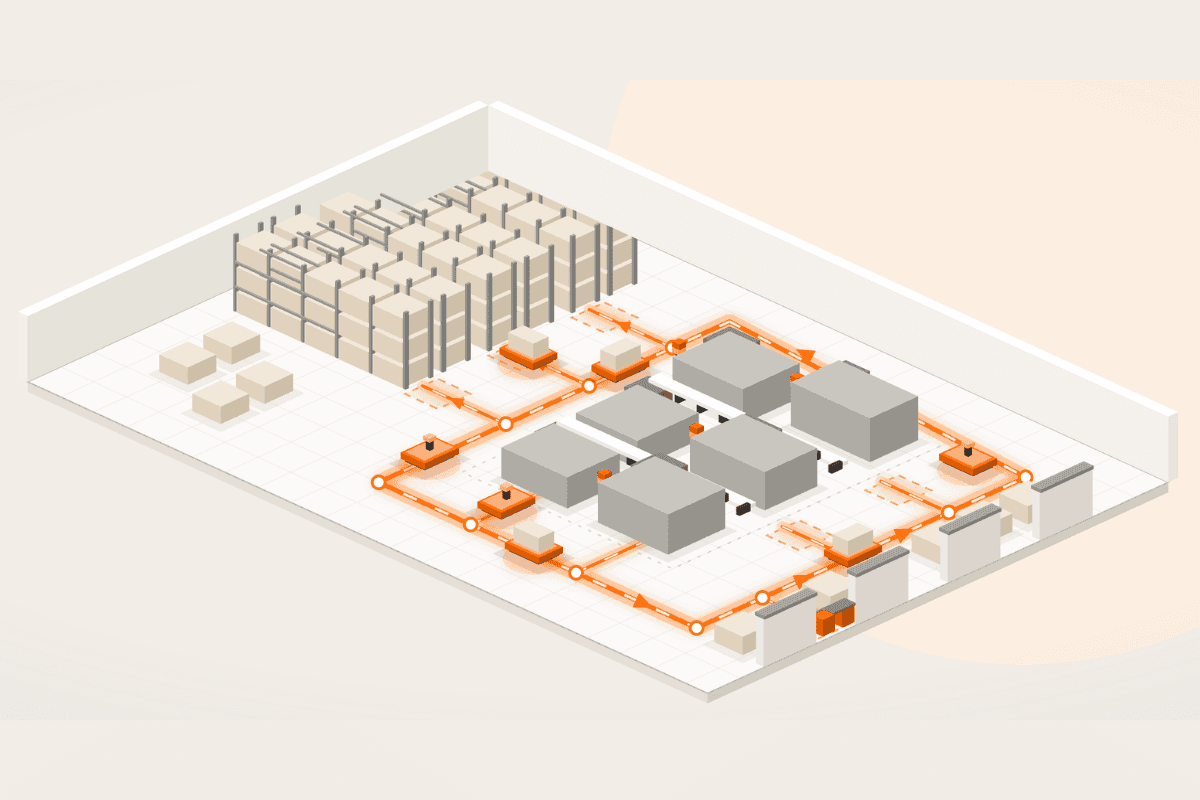
The most effective approach is to define the factory floor as two distinct types of space: production cells and AGV travel corridors. Production cells contain everything associated with human work: the workstation, the racks, the trolley storage, and any utilities the cell needs to operate. What is inside the cell can be reconfigured freely for seasonal demand peaks or product mix changes without affecting AGV routes. The corridors outside the cells are reserved for AGV travel and are not subject to ad-hoc repositioning.
This model gives manufacturing teams the flexibility they need for high-mix low-volume production while giving the AGV fleet the predictable path structure it requires to operate reliably.
No pre-planned AGV zones
AGV deployment does not need to happen all at once. A phased approach that starts with one zone and expands over time is practical and lower-risk. What is not practical is deploying the first AGV into a layout that was not designed with future zones in mind.
Before the first vehicle arrives, designate which zones of the floor will eventually be served by AGVs. Even if those zones remain manual for the next twelve months, their layout should already reflect AGV requirements: aisle widths, clear path structures, and defined pick-up and drop-off points. Designing for future AGV zones at the outset costs nothing. Retrofitting a layout that was not designed for them costs significantly more.
Floor quality
Production-grade green epoxy flooring is the practical standard for AGV-compatible factory floors in Vietnamese manufacturing environments. It provides the surface consistency AGV navigation systems require, withstands industrial cleaning, and handles the load cycles of both AGVs and conventional material handling equipment.
For facilities where full floor resurfacing is not immediately feasible, a phased approach works: resurface the designated AGV travel corridors first, leaving production cell interiors on their current surface. This limits the resurfacing scope to the paths the AGV will actually use.
Network blackout zones
Network dead zones do not require a full WiFi infrastructure overhaul before AGV deployment. The right vehicle specification solves most coverage problems without additional network investment.
When evaluating AGV options for facilities with known dead zones, prioritize vehicles that support antenna repositioning to optimize coverage geometry, allow installation of additional omnidirectional antennas, support map pre-loading so the vehicle can navigate through a dead zone without continuous network contact, and support QR code-based position re-initialization to recover accurate positioning after a network gap. A combination of these features in the vehicle specification eliminates most ghost-stop scenarios without requiring changes to the facility's network infrastructure.
Charging, parking, and maintenance space
The constraint of limited dedicated space for AGV infrastructure is solvable through vehicle selection. Two capabilities change the space equation significantly.
Opportunity charging allows the vehicle to charge briefly at defined points along its operating route rather than returning to a dedicated charging bay. This eliminates the need for a large centralized charging area and reduces the fleet size required to maintain throughput during charging cycles.
Hot-swappable batteries allow a depleted battery to be replaced in minutes without removing the vehicle from service. A small battery storage and swap station occupies significantly less space than a fleet of vehicles parked at charging docks.
Both capabilities should be evaluated against the specific operating cycle and facility constraints before vehicle selection is finalized.
FAQ
What is AGV floor layout design?
AGV floor layout design is the process of configuring a factory or warehouse floor to support autonomous guided vehicle operations. It covers aisle width specification, traffic zone separation, charging and maintenance space planning, network coverage assessment, and floor surface preparation. Effective AGV floor layout design happens before vehicle selection. The layout determines what the vehicle can achieve in that environment.
Why do AGVs stop without apparent reason on the factory floor?
Unexplained AGV stops, sometimes called ghost stops, are typically caused by WiFi dead zones in the facility. Dense equipment layouts and metal structures block network coverage in localized areas. When an AGV loses network contact in a dead zone, it stops as a safety default. The solution is a combination of network coverage assessment before deployment and vehicle specification that supports dead zone navigation: map pre-loading, omnidirectional antenna options, and QR code-based position re-initialization.
What flooring is required for AGV operations?
AGVs require consistent, level floor surfaces to maintain positioning accuracy and navigate reliably at operating speed. In Vietnamese manufacturing environments, production-grade green epoxy flooring is the practical standard. It provides the surface quality AGV navigation systems require and is compatible with industrial cleaning and normal material handling operations. For facilities where full resurfacing is not feasible immediately, prioritizing the AGV travel corridors for resurfacing limits the scope and cost while delivering the surface consistency the fleet needs.
How do you separate human and AGV work areas on the factory floor?
The most effective approach is to define the floor as production cells and AGV travel corridors. Production cells contain all human work areas and their associated equipment: workstations, racks, trolley storage, and utilities. Everything inside the cell can be reconfigured for seasonal demand without affecting AGV routes. The corridors outside production cells are reserved for AGV travel and are not subject to ad-hoc repositioning. This model gives manufacturing teams operational flexibility while giving the AGV fleet the predictable path structure it needs.
How do you handle AGV charging in a factory with limited space?
Two vehicle capabilities significantly reduce the space required for AGV charging infrastructure. Opportunity charging allows the vehicle to top up at defined points along its operating route, eliminating the need for a large centralized charging bay. Hot-swappable batteries allow a depleted battery to be replaced in minutes without removing the vehicle from service, replacing a fleet of parked charging vehicles with a compact battery storage and swap station. Both options should be evaluated against the facility's specific operating cycle and available space before vehicle selection.
Can AGVs be deployed in stages rather than all at once?
Yes, and a staged deployment approach is often lower risk for mid-market manufacturers. The critical requirement is that the initial floor layout accounts for future AGV zones even before those zones go live. Aisle widths, path structures, and pick-up and drop-off points for planned future zones should be designed into the layout before the first vehicle arrives. Retrofitting a layout that was not designed for future AGV expansion is consistently more expensive than planning for it at the outset.
About the author
Rosie Nguyen
Rosie Nguyen works at the intersection of Marketing, Communications, and meaningful Storytelling at Gradion. She covers leadership and scaling, writing for the founders and operators building across Asia.
Is your floor ready for AGVs?
We help manufacturers assess shopfloor density, infrastructure, and traffic conditions before vehicle selection, so AGV deployment avoids the retrofits that cause most first-deployment underperformance.