
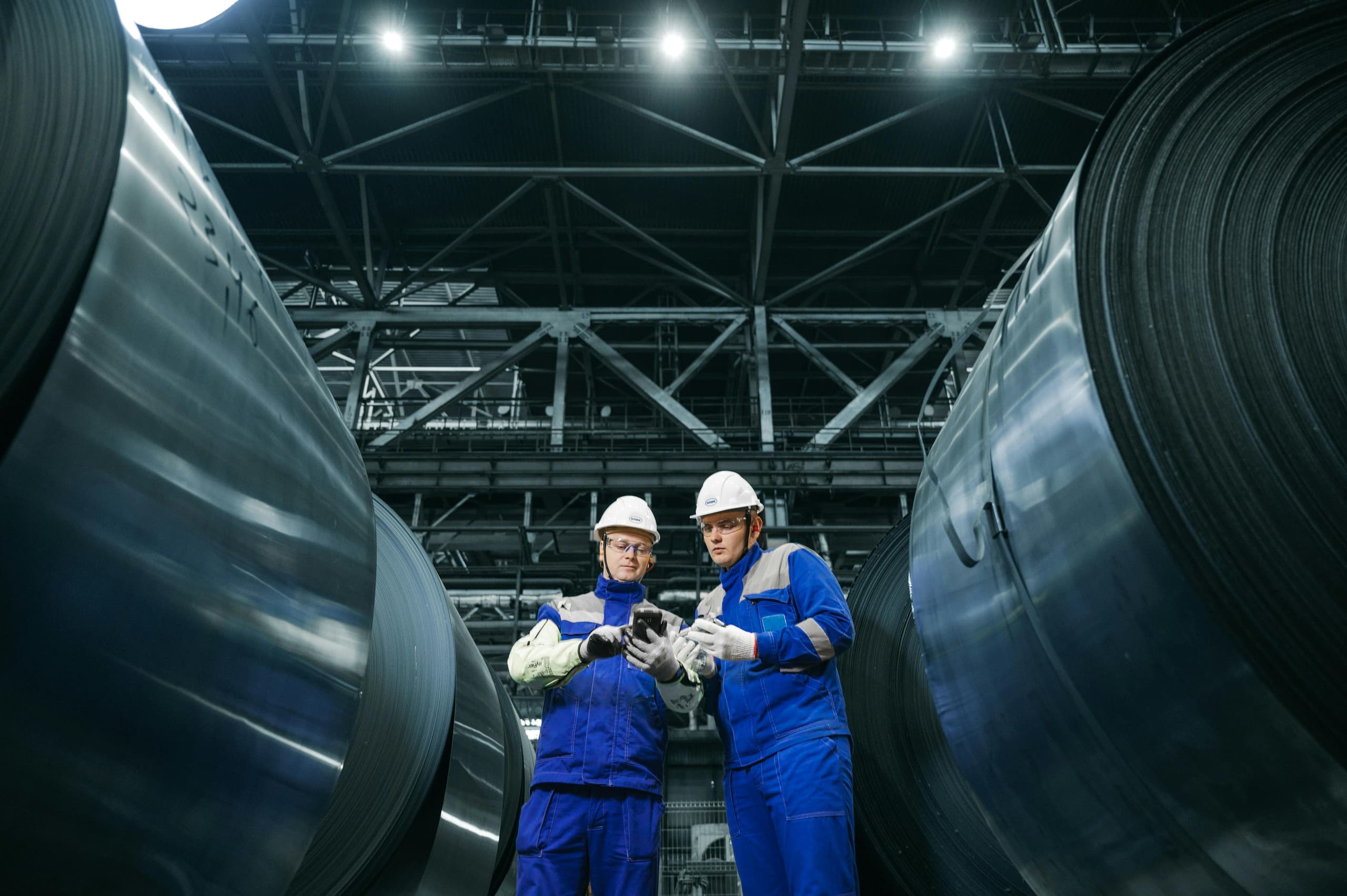
Your Factory Isn’t Ready for AI. Your Workers Already Are.

Rosie Nguyen
2 June 2026
Insights from the Scaling Business Summit 2026, Ho Chi Minh City.
The dream has a name: the dark factory. No workers. No holidays. No strikes. A plant running 24 hours a day, seven days a week, on demand. It is the image that has driven AI investment conversations in manufacturing for a decade. David Will, General Director at DRÄXLMAIER Vietnam, walked onto the SBS stage and said what most plant managers think but rarely say out loud: nobody alive today will see it.
DRÄXLMAIER is not a fringe experiment. It is a 65,000-employee, €5 billion automotive supplier from Lower Bavaria, one of the hidden giants behind the instrument panels, electronic components, and high-voltage battery packs in BMW and Mercedes vehicles. Its Vietnam operation exists specifically because its flagship product, the automotive wiring harness, is 70% manual labor by design. No robot has cracked it yet.
What followed was not a pessimistic take on AI. It was an honest one. David mapped where manufacturing AI actually is, why it gets stuck, and what questions every plant manager needs to answer before committing to the revolution.
1. The Dark Factory Is Not Coming. Stop Planning for It.
The vision is well-defined. Ask ChatGPT what the future of cable manufacturing looks like and it generates images of a near-automated facility: computer vision cameras, man-machine interfaces, automated quality inspection. Ask Microsoft Copilot and you get AR headsets, predictive maintenance systems, and digital work instructions. Both pictures look impressive. Both still have people in them.
David’s point was not that the technology is useless. It was that the target, a factory operating entirely without human interference is a very far vision. Chinese manufacturers have claimed the dark factory title. Anyone who has spent time in maintenance knows the reality. “It’s probably about hours and not days how a factory can really run in that mode.”
DRÄXLMAIER’s honest position on the Gartner AI maturity model: somewhere between active and operational. Not spearheading. Not close to systemic transformation. A deliberate fast follower, building critical mass before committing to a direction. “We are not ahead of the game. We are not spearheading. We’re trying to be a fast follower.”
Lesson 1: The dark factory is a planning horizon, not a near-term roadmap. The companies who admit that will invest smarter than the ones who don’t.
2. Office AI Sprinted. Factory AI Is Still Warming Up.
The gap inside DRÄXLMAIER is striking. On the office side, the company is meaningfully advanced: AI-assisted IT ticketing, automated patent drafting workflows, internal knowledge search built on RAG, and agentic systems built with Microsoft that let non-technical staff automate administrative processes themselves. David pointed to logistics control, material ordering, and production scheduling as areas with “tremendous potential” once agent frameworks reach the plant floor.
Then there is manufacturing. Still in experimentation. A handful of pilot projects. Islands of proof-of-concept separated by significant distance from scaled deployment.
“I feel like we are significantly more developed in office applications, especially with the generative AI models and the agents, than we are in manufacturing.”
The asymmetry is not unique to DRÄXLMAIER. Text and numbers, the raw material of office work are what current AI models handle best. Physical processes, spatial reasoning, multi-variant quality inspection: harder problems, and the gap between lab accuracy and production requirements is larger than most AI vendors admit.
Lesson 2: Office AI and factory AI are different disciplines on different timelines. Treat them as separate roadmaps and you will make better decisions on both.
3. Variation Is the Variable That Breaks the Model
The projects that work at DRÄXLMAIER share one characteristic: low variation. A shunt, a small electronic component produces a consistent shape with one defined defect type. Computer vision trained on that part can reliably detect air pocket defects. A bowden cable either locks or it does not. A two-dimensional image is sufficient. Both are tractable problems.
The wiring harness is not. It is a branching, flexible assembly that changes based on every configuration option the buyer selects. Seat heating or no seat heating. This trim or that. The harness for a premium SUV looks different across hundreds of variants. Variation is not an edge case. It is the product. “You have a huge variation in the product. With 70% of manual labor in that product, at the same time you have a huge risk for defects that are very difficult to control.”

Training a model to handle high-variation, flexible assembly and then to adapt when the product specification changes is a fundamentally different problem from training it on a homogeneous part. The development timeline for DRÄXLMAIER’s current process monitoring pilot: over one year, in partnership with a major industrial partner, and not yet fully deployed.
Lesson 3: Before any factory AI project, ask: how much does our product vary, and what does that variation do to the training cost and retraining cycle?
4. 95% Accuracy Is a Problem, Not a Milestone
A question from the audience surfaced one of the session’s sharpest moments. An attendee asked about sensor accuracy rates in factory environments with electromagnetic interference and vibration. David’s answer cut to the core of the manufacturing AI problem.
“The models we have seen have 95% accuracy. We have learned in automotive this is impossible to accept.”
Automotive quality is measured in parts per million. Delivering one million wiring harnesses to BMW means a maximum of 200 defects across the entire batch. 95% accuracy produces 50,000 defects per million. The gap between what AI currently delivers and what the automotive supply chain requires is not a calibration issue. It is a fundamental mismatch between the technology’s current capability and the industry’s non-negotiable standard.
This is why DRÄXLMAIER cannot hand over quality inspection to AI in its current state. The technology catches defects. It just does not catch enough of them and in automotive, the ones it misses are the ones that cause recalls.
Lesson 4: AI accuracy in manufacturing is not measured against a generic benchmark. It is measured against the customer’s defect tolerance. Know that number before you start the project.
5. The Question That Stops the Revolution
David closed with the question every plant manager in the room was already carrying. “As a plant manager, there is no return on investment. Does it really make sense to train an AI for one year and under which circumstances, or does it make sense rather to work here in Vietnam with the Vietnamese workers and continue that kind of business?”
This is not AI skepticism. It is process economics. The conditions that make an AI investment worthwhile are specific: low product variation, process stability, predictable output, and confidence that the model will not require full retraining every time a specification changes. When those conditions are met, the investment calculus shifts. When they are not, continuing with a skilled workforce is not a failure of ambition. It is the correct decision.
The irony DRÄXLMAIER discovered: their workforce was ready for AI before their processes were. Employees were already using external AI tools so aggressively the company had to ban them. The bottleneck was never adoption. It was the nature of the product. “It’s not the workforce which is not AI-ready. The organization even has to protect itself from that momentum.”
Lesson 5: The bottleneck in manufacturing AI is rarely the workforce. It is usually the product and the process. Solve the right problem.
The CEO Execution Playbook: What to Do Tomorrow
- 1. Separate your office AI roadmap from your factory AI roadmap. The tools, timelines, and return profiles are different. Treating them as one initiative produces confused priorities and misleading metrics.
- 2. Run a variation audit on your highest-volume process. Identify your most automation-friendly candidate: low variation, stable output, clear defect definition. Start there. Do not start with your most complex product.
- 3. Ask your AI vendor for their parts-per-million equivalent. Before any quality inspection contract, get the vendor to express their accuracy claim in the unit your customers use to measure you. The gap will be informative.
- 4. Calculate the full retraining cost. When your product spec changes, and it will, what does it cost to retrain or adapt the model? Add that to the total cost of ownership before approving the project.
- 5. Find out what your workforce is already using. DRÄXLMAIER’s employees were ahead of the organization. Survey your teams. The unsanctioned tools they are already using tell you where the real appetite is, and often point to the highest-value starting points.
About the author
Rosie Nguyen
Rosie Nguyen works at the intersection of Marketing, Communications, and meaningful Storytelling at Gradion. She covers leadership and scaling, writing for the founders and operators building across Asia.
Your workers are ready for AI. Is your factory infrastructure?
If you're navigating AI deployment in manufacturing, let's have an honest conversation.